
hormone check for women
Hormone Check for Women: A Decision Guide to Testing and Clinician-Led Evaluation

Start with the decision behind a hormone check
A hormone check is most useful when it answers a defined clinical question rather than serving as a general search for an explanation. If you are dealing with changes in bleeding, temperature, sleep, mood, energy, or other concerns that may relate to a life-stage transition, start by deciding what you want the evaluation to clarify.
You may be asking whether your symptoms fit a recognizable pattern, whether a laboratory measurement could add useful information, or whether another concern needs attention first. Those are different questions. They should not all be handled by ordering the same panel and comparing the result with an online reference range.
Start with three decisions:
- What has changed, and what pattern does it follow?
- Could testing meaningfully support the question you are asking?
- Does any symptom require timely clinical attention before you focus on hormone numbers?
A laboratory result is one part of an evaluation. Symptoms, life stage, menstrual or bleeding history, medical history, and medications can change how a result is understood. A result should not become a diagnosis simply because it is marked high, low, or outside a reference range.
This decision guide helps you choose a sensible next step; it does not diagnose a hormonal condition or tell you which tests you personally need. The practical aim is narrower: distinguish a question suitable for a planned clinician discussion from a concern that should not be left to self-directed testing.
You can use the guide before ordering a test, after receiving a result, or while preparing for an appointment. In each situation, keep the same boundary in view: a laboratory number needs the question, timing, and personal context that give it meaning.
What a hormone check is meant to clarify
A hormone check is meant to clarify a clinical question, not to produce a single verdict about your health. The question may involve a change in your usual pattern, uncertainty about where you are in a life stage, or whether a laboratory measurement would add information that symptoms and history cannot provide on their own.
The same result can carry different meaning in different circumstances. Your age, symptom pattern, bleeding history, medication use, and whether menstrual changes can be used as a marker all affect the conversation. A test may support clinical reasoning in one situation and add little in another.
For women over 45 who present with symptoms associated with this life-stage transition, NICE guidance says diagnosis is based on symptoms without confirmatory laboratory tests. That does not mean symptoms should be ignored or that testing is never relevant. It means the test should have a clear purpose before you rely on it.
A clinician-guided discussion can frame the question more precisely:
- Are the symptoms typical enough that a clinical assessment provides the main information?
- Is the presentation unusual enough that testing may add supporting information?
- Is the usual menstrual pattern unavailable because of a prior hysterectomy or another reason?
- Could medication use make a result difficult to interpret?
- Would another measurement or follow-up discussion answer the concern better than one isolated result?
The answers determine whether a laboratory result is likely to move the decision forward. They also reduce the risk of treating a number as more definitive than it is. Your goal is not to collect every possible measurement; your goal is to connect any measurement to a question that matters.
Overview
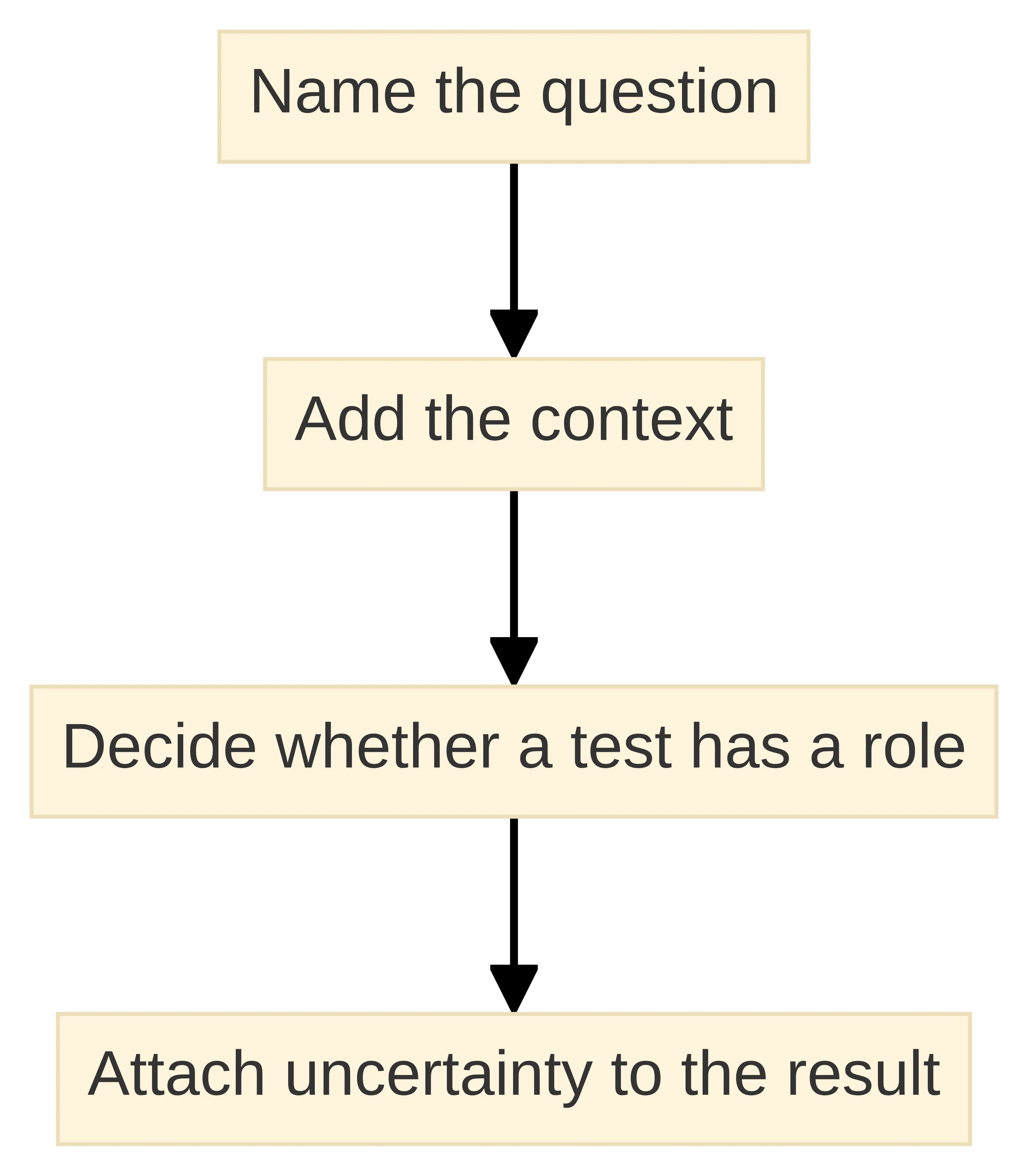
Use this four-part framework when you are deciding what to do next:
- Name the question. Write down the change or concern you want explained. “I feel different” is a real concern, but a clinician can work with a more specific pattern, such as a change in bleeding or a group of symptoms that appeared together.
- Add the context. Note your life stage, relevant history, medications, and whether your usual cycle or bleeding pattern can be used as information. Context changes the meaning of testing.
- Decide whether a test has a role. Some situations are assessed mainly through symptoms and history. Others may call for selected measurements or, sometimes, more than one measurement over time. You do not need to decide that from a result ordered without context.
- Attach uncertainty to the result. Use the laboratory’s own reference range, then discuss what the number does and does not establish. A result outside the range is not automatically an illness, and a result inside the range does not settle every health question.
Focus on the purpose of testing, the context that changes interpretation, the signs that should prompt timely care, and the practical route to a clinician-led discussion.
The framework gives you a clear boundary. Use a planned evaluation when you need help understanding a pattern or deciding whether testing adds value. Do not use a self-ordered result as a substitute for clinical assessment, particularly when bleeding has changed in a concerning way.
If you already have a result, begin with the report rather than an online interpretation. If you do not have a result, begin with the clinical question rather than a broad testing panel. Both routes lead to the same useful next step: connect the concern with a clinician who can interpret it in context.
Why symptoms and life stage change the meaning of testing
Symptoms and life stage change the meaning of hormone testing because hormone levels and clinical patterns are not interpreted in isolation. For women over 45 with symptoms associated with this transition, NICE guidance says diagnosis is based on symptoms without confirmatory laboratory tests. A laboratory value may therefore add less information than you expect when the overall pattern already guides the clinical assessment.
The situation can differ when the presentation is atypical or when you are under 45. The cited clinical guidance says gonadotrophin testing may help in atypical presentations or in women under 45, and that serial measurements may sometimes provide supporting information. That is a reason for a clinician to decide whether testing has a role, not a reason to create your own testing schedule.
Gonadotrophin levels can fluctuate during this transition. A result taken at one point may not represent a stable pattern, which is why a single number may not answer the question you are trying to ask.
Medication history is part of the context. Contraceptive pills can suppress gonadotrophin results and make low levels difficult to interpret. Hormonal birth control can also change bleeding patterns, including breakthrough bleeding. Blood thinners and aspirin can contribute to heavy menstrual bleeding.
These effects do not tell you what is causing your symptoms. They tell you why a clinician needs to know what you take and how your bleeding or other symptoms have changed before attaching meaning to a result. Bring the medication name, dose if known, and reason for use to the discussion rather than leaving medication history out of the testing question.
Your medical history matters for the same reason. A prior hysterectomy, changes in menstrual patterns, and the timing of symptoms can affect which clinical clues are available. Record those details without trying to turn them into a diagnosis.
Your next step should match the context: record the pattern and arrange a clinician discussion when the question is uncertain; do not infer a hormonal problem from a symptom or result that has not been interpreted alongside your history and medications.
A short timeline is often more useful than a long list of isolated symptoms. Note when the change began, whether it is recurring or persistent, and whether medication or contraception changed around the same time. Take that timeline to the discussion.
When testing may support—not replace—clinical evaluation
Testing may support clinical evaluation when the usual clues are unavailable, the presentation is atypical, or a clinician believes a measurement could add information. It does not replace the assessment that gives the measurement meaning.
The reviewed clinical guidance found that no single parameter, including hot flushes, was useful by itself for making this diagnosis. In a cited case involving a 47-year-old woman, gonadotrophin testing was described as rarely helpful: normal results did not exclude the condition being considered, and raised results did not necessarily confirm it. The practical lesson is simple: a number can support a decision without deciding the whole question.
Testing may be relevant when menstrual absence cannot be used as a marker, including after a hysterectomy. It can also be relevant in an atypical presentation or for a woman under 45. Even in those situations, the result needs to be considered with the reason for testing, the timing, the symptom pattern, and medication use.
Use these decision branches:
- If your symptoms and life stage form a pattern that a clinician can assess clinically: arrange that assessment rather than ordering a broad panel simply to obtain a number.
- If your presentation is atypical, you are under 45, or the usual menstrual marker is unavailable: ask a clinician whether selected testing could add supporting information.
- If you take hormonal contraception: disclose it before testing is interpreted, because it can suppress gonadotrophin results and make low levels difficult to interpret.
- If someone recommends repeat measurements: ask what decision the additional measurements are intended to inform; serial testing may sometimes add supporting information, but it is not a universal requirement.
The supported action in every branch is the same: make the test serve a defined clinical question instead of asking the test to create the question for you.
A test result cannot settle the whole concern when the clinical question is broader than the measurement. A hormone value may contribute to a discussion about a symptom pattern, but it cannot independently explain every change in sleep, mood, bleeding, energy, or temperature.
That boundary protects you from two opposite mistakes. You might dismiss a real concern because one result appears ordinary, or you might assume a condition because one result is flagged. Keep the result connected to the decision it was intended to inform, and let the clinical assessment determine what happens next.
Read the result with its uncertainty attached
Read a laboratory result with the report’s own reference range and the circumstances in which the sample was taken. Reference ranges can vary between laboratories because equipment, reagents, and analysis techniques can differ. A range from one laboratory should not automatically be transferred to a result from another.
Use the reference range supplied by the laboratory that performed the test. Keep the original report so the clinician can see the test name, result, units, range, and report comments together. A screenshot that shows only the flagged number removes information that may matter to interpretation.
The test date also belongs with the result. A value taken during one symptom pattern or medication schedule may not answer a later question without that timing attached.
A result within the reference range does not establish that no health problem is present. Results from healthy people and people with disease can overlap, and some disease-related results can remain within the reference range. A result outside the reference range also does not by itself mean that you are sick.
That uncertainty is not a flaw in your report. It is a reason to keep the result attached to the question it was meant to answer. If the question was whether a single value could explain every symptom, the result cannot carry that weight. If the question was narrower, the clinician can explain what the result contributes and what remains unresolved.
Before discussing a result, gather four details:
- The exact test and the date it was performed.
- The laboratory’s reference range and units.
- Any medication or contraceptive use that could affect interpretation.
- The symptoms, bleeding pattern, and life-stage context that prompted the test.
Then ask what decision the result changes. If it changes no decision, it may be information without direction. If it changes a clinical next step, that step should come from the full evaluation rather than from the flagged label alone.
Avoid comparing your value with a reference interval copied from a different laboratory or with an isolated number from a social media post. The report that belongs to your test is the relevant starting point.
Separate a routine testing question from a concern that should not wait
A routine testing question is usually something you can prepare for: you have noticed a pattern, you want to understand whether testing could add information, and you are not using a result to explain away a concerning change. Write down what changed and arrange a clinician conversation that can address the pattern rather than only the laboratory number.
A concern that should not wait is one where bleeding or another symptom needs clinical attention in its own right. Do not let a normal-looking result reassure you away from that evaluation, and do not let an abnormal result become your diagnosis.
If you are unsure which category fits, describe the symptom and its timing when you contact a clinician. Do not make the laboratory question a substitute for describing the symptom itself.
Abnormal uterine bleeding can be an early sign of endometrial cancer, according to the cited American College of Obstetricians and Gynecologists information. That statement does not identify the cause of your bleeding, but it establishes why abnormal bleeding should be discussed with a clinician rather than managed through self-directed hormone testing alone.
Hormonal birth control can change bleeding patterns, and blood thinners or aspirin can contribute to heavy menstrual bleeding. Those medication-related possibilities still require context; they should not be used as a reason to dismiss a new, persistent, or concerning change.
Describe the bleeding plainly: what changed from your usual pattern, when it began, how often it occurs, and which medications or contraception you use. Those details help keep the discussion focused on the symptom that needs attention.
Bring your medication list and describe the change accurately. A hormone panel may be part of a clinician’s reasoning in some circumstances, but it should not delay evaluation of the symptom that prompted you to seek help.
Do not wait for a self-ordered result before raising a new or concerning bleeding change. The clinical question is the bleeding pattern and its possible causes, not simply whether a hormone value falls inside a reference interval.
Prepare for a clinician-guided hormone discussion
Preparation makes the discussion more specific without requiring you to diagnose yourself. Misra Wellness recommends bringing relevant medical records, a medication list, and a summary of your medical history to an appointment. Those materials give the clinician a view of the question over time rather than a single isolated result.
Before the visit, prepare a short record with:
- The main change you want to discuss and when you first noticed it.
- The pattern of bleeding or other symptoms, including what has changed from your usual experience.
- Current medications, hormonal contraception, supplements if relevant, and recent changes you remember.
- Prior laboratory reports or medical records that relate to the concern.
- The outcome you want from the conversation: understanding the pattern, deciding whether testing has a role, or identifying what needs timely attention.
Keep the record factual. You do not need to label the cause before the discussion.
Useful questions keep the conversation focused:
- What clinical question are we trying to answer?
- Could my symptoms and life stage provide more useful information than a single laboratory measurement?
- Could my medication or contraceptive use affect the result?
- If testing is considered, what would a result within or outside the laboratory range change?
- If the result does not explain the pattern, what part of the concern still needs attention?
- Would another measurement over time add information, and what decision would it support?
You can bring a test result without bringing a conclusion. Let the clinician decide how much weight the result deserves alongside your history and symptoms.
Your direct preparation step is to gather the records, medication list, and history summary, then write the question in one sentence. That gives the appointment a starting point without committing you to a particular test, diagnosis, or treatment.
If you have several concerns, place the one that affects your next decision first. For example, you may want to understand a symptom pattern, decide whether laboratory testing has a role, or discuss a bleeding change that needs attention. Naming the priority helps the conversation move from a list of numbers to a useful clinical question.
What Misra Wellness can offer as the next step
At Misra Wellness, we offer a standalone 90-minute consultation for hormone health.
The consultation is a starting point for discussion, not a promise of a diagnosis, treatment plan, eligibility, or appointment time. Bring the record and questions described above so the conversation can begin with your actual pattern rather than a predetermined result.
At Misra Wellness, our full-scope membership primary care includes women’s and hormone health, metabolic and integrative medicine, and everyday care. Our full DPC membership also includes hormone and metabolic health, integrative and preventive medicine, and related mental-health support.
Those are different pathways for different needs. A standalone consultation is a focused starting point for a hormone-related question. Membership primary care provides a broader ongoing care setting. The appropriate route depends on the scope of the concern and the care relationship you are seeking; neither route assumes a diagnosis, a treatment plan, or eligibility before a clinician evaluates your situation.
Misra Wellness serves adults in California and New York. If you are seeking clinician-guided evaluation in one of those states, bring the question and preparation record described above so the conversation can begin with your actual pattern rather than a predetermined result.
You do not need to decide in advance which laboratory measurements belong in the discussion. You can bring the concern, its timeline, your medication information, and any existing reports.
Request a consultation without assuming the outcome
The useful goal is not to obtain a hormone number at any cost. It is to understand which question needs answering, whether testing can help, and whether a symptom deserves timely attention on its own. Bring the pattern, the medication history, and the original laboratory report if you have one. A qualified clinician decides what evaluation is appropriate for your situation.
For adults in California and New York who want that clinician-led discussion, Misra Wellness provides a consultation pathway without requiring you to arrive with a diagnosis or a predetermined test. Submitting a consultation request does not reserve an appointment time.
What should you bring to a hormone consultation?
What is the purpose of a hormone check for women?
A hormone check is intended to clarify specific clinical questions related to symptoms, life stage, or changes in health patterns, rather than providing a definitive diagnosis. It helps determine if testing could add useful information to a clinician’s assessment.
How should I prepare for a consultation regarding hormone health?
Before your consultation, gather relevant medical records, a list of medications, and a summary of your medical history. Prepare to discuss the specific changes or symptoms you want to address, as well as any questions you have about your hormone health.
How does medication affect hormone testing results?
Certain medications, such as hormonal birth control, can influence hormone levels and test results. It’s important to disclose any medications you are taking to your clinician, as they can affect the interpretation of test results.
What can I expect from a consultation at Misra Wellness?
At Misra Wellness, you can expect a standalone 90-minute consultation focused on your hormone health.
When is hormone testing relevant for women under 45?
Hormone testing may be relevant for women under 45 if they present atypical symptoms or if their usual menstrual patterns are unavailable. In such cases, a clinician may recommend testing to gather additional information.
What limitations should I be aware of regarding hormone testing?
Hormone testing results should not be treated as standalone diagnoses. Factors such as symptoms, life stage, medical history, and medications can all influence the interpretation of results, and a clinician’s evaluation is essential for accurate assessment.
Ready for a real plan?
Work directly with Dr. Misra — no insurance, no rush.
Misra Wellness is a virtual-first Direct Primary Care practice serving California and New York. Book a meet & greet to see if we're the right fit.
Book a meet & greet