
bioidentical hormone replacement therapy
Bioidentical Hormone Replacement Therapy: A Decision Guide for Clinician-Supervised Care

Make the label a starting question, not a treatment decision
The term “bioidentical” appears in discussions of both FDA-approved and compounded hormone preparations, so it needs clinical context before it can guide a decision. The term alone does not establish that a preparation is safer, more effective, FDA-approved, or suitable for you, and it does not resolve whether the product is compounded. ACOG notes that compounded preparations may be marketed as natural, safer, or more effective than FDA-approved medications, but evidence supporting those marketing claims is lacking.
Hormone therapy is the broader treatment category. ACOG describes hormone therapy as a medical treatment that can help relieve symptoms associated with hormonal transition, and the therapy is also called hormone replacement therapy or menopausal hormone therapy. Some FDA-approved hormone medications use bioidentical hormones, synthetic hormones, or both. Compounded preparations are a separate regulatory question, not automatically the same thing as an FDA-approved product.
A sound treatment decision starts with the health problem rather than the product label:
- Define the symptoms or health concern you want to address.
- Review your medical history, current medicines, family history, and relevant risk factors.
- Ask which formulation is being considered and whether an FDA-approved option is available.
- Discuss expected benefits, limitations, risks, monitoring, and follow-up before deciding.
The sequence does not tell you to start, stop, or adjust hormones. It helps you turn a broad search term into a focused clinical conversation.
Separate FDA-approved options from compounded preparations
FDA-approved hormone options and compounded preparations belong in separate parts of the treatment discussion. ACOG says compounded bioidentical hormone therapy should not be prescribed routinely when FDA-approved formulations are available. ACOG also says compounded preparations are not FDA-approved and may carry risks specific to compounding.
Regulatory status answers one question; personal suitability answers another. A compounded status does not, by itself, establish that a preparation is unsafe, while FDA approval does not make every option appropriate for every person. The supported distinction is that the two categories have different approval and compounding considerations. The evidence does not support treating the word “bioidentical” as proof of superior safety or effectiveness.
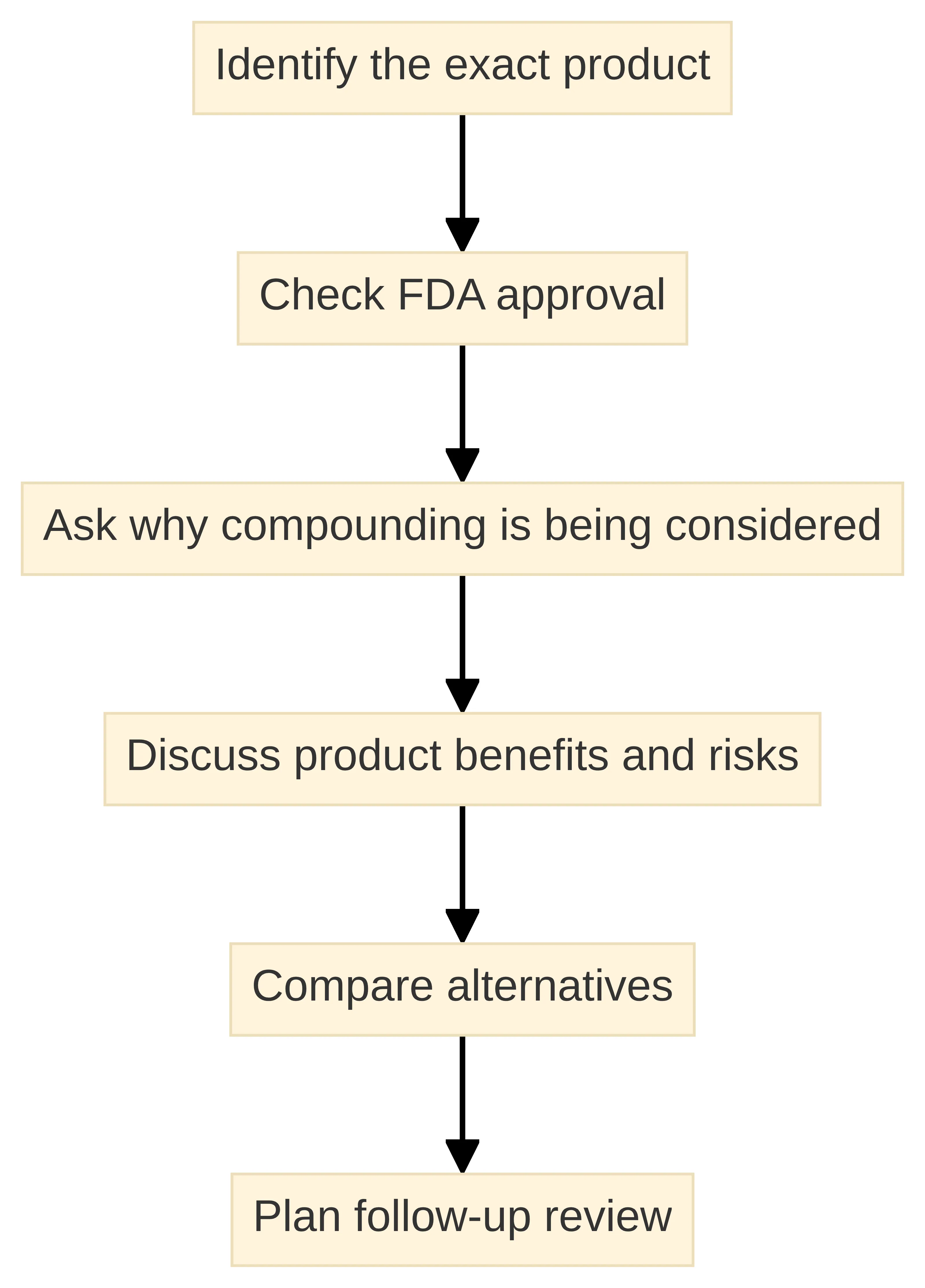
A product discussion should answer these questions before you make a decision:
- Is the proposed product FDA-approved for the intended use?
- If the product is compounded, why is it being considered when an FDA-approved formulation exists?
- What potential benefits and risks are specific to the product and its formulation?
- What alternatives should you compare based on your symptoms, goals, and medical history?
- What follow-up will determine whether continuing the treatment still makes sense?
ACOG recommends counseling people who request compounded preparations about their lack of FDA approval and their potential benefits and risks, including risks specific to compounding.
Marketing language cannot substitute for product identification. Ask for the exact hormone, formulation, route, regulatory status, and reason for considering it. A clear answer lets you discuss the actual treatment rather than relying on an implication attached to a label. These answers also help identify what remains uncertain. If the exact product cannot be identified, you cannot meaningfully compare its regulatory status, formulation, or stated purpose. If it is compounded, ask what clinical circumstance makes it worth considering and what FDA-approved alternatives were reviewed. If an approved option is proposed, ask which features make it fit the stated goal and what limitations remain. The point is not to treat approval as a personal recommendation or compounding as an automatic prohibition. The point is to require a product-specific explanation before accepting a broad label as evidence.
Match potential benefit to the problem being treated
Hormone therapy can help relieve certain symptoms associated with hormonal transition, but that possibility does not make it a general treatment for every change in mood, sleep, energy, weight, or sexual health. Start by naming the problem you want to address rather than asking whether a hormone label sounds right. A clinician can then consider whether your symptom pattern has a plausible connection to hormone changes or needs another evaluation.
A symptom-focused goal gives the consultation something concrete to examine. Record what you notice, when it began, how often it occurs, how it affects daily life, and what you have already tried. Then ask what improvement would count as meaningful, what limitations should be expected, and what would prompt a change in plan. A treatment decision should be tied to your symptoms and priorities, not to the promise implied by a product name.
A symptom pattern can have more than one possible explanation. Share the full pattern with the clinician, including changes that seem unrelated to hormones, because treatment selection depends on your health history, baseline risks, goals, and priorities rather than on one symptom alone. Ask what needs evaluation before hormone therapy is considered. Separate your main goal from secondary concerns when you prepare for the visit. Ask which concern the proposed option is intended to address and which concerns may need a different evaluation. This prevents one treatment discussion from being treated as an answer to every symptom and gives the clinician a clearer basis for discussing expected benefit, limitations, and next steps.
Ongoing treatment needs ongoing review. ACOG advises an annual discussion with a clinician about whether to continue hormone therapy, based on symptoms, risks, and benefits. The discussion gives you a chance to revisit the original goal, consider new health information, and decide whether the balance still supports continuing. A yearly conversation does not replace earlier contact if a new or concerning symptom appears.
Use individualized risk review instead of a blanket eligibility rule
Hormone-therapy candidacy depends on more than age or a single symptom. ACOG recommends shared decision-making that considers your symptoms, medical history, baseline cardiovascular risk, breast-cancer risk, venous-thromboembolism risk, treatment goals, and priorities. Those factors explain why an option that may be reasonable in one clinical context may not be reasonable in another.
ACOG also describes a timing consideration for people without contraindications: initiation before age 60 or within 10 years of the start of spontaneous menopause. That timing point is not a universal eligibility rule. Your clinician still needs to connect it with your history, baseline risks, symptoms, and goals before discussing a particular treatment. Use this timing information as a prompt to report when symptoms began and to discuss relevant history, not as a deadline or cutoff that determines your care by itself.
Venous-thromboembolism risk belongs in the conversation before treatment begins. The cited ACOG opinion states that hormone therapy is associated with this risk and that the relative risk may be greater when preexisting factors such as obesity, immobilization, or fracture are present. Tell your clinician about those factors, any prior clotting event, relevant medical conditions, and medicines that may affect the discussion.
A practical risk record can include:
- Your age and the timing of the symptoms you want to address.
- Personal and family medical history relevant to cardiovascular disease, breast cancer, or blood clots.
- Current medicines, supplements, and prior hormone use.
- Health conditions, recent procedures, periods of limited movement, or previous fractures.
- The treatment goal you want to discuss and the concerns that might change your decision.
Bring the record to the consultation rather than trying to decide eligibility from a general checklist. Risk review is also a way to find missing information, not only to list possible concerns. If you are unsure whether a prior event, family history, or medication matters, write it down rather than filtering it out yourself. Ask which details could change the options, which might require additional assessment, and which would simply be followed over time. This keeps a risk factor from being treated as an automatic yes-or-no answer and keeps an incomplete history from being mistaken for a conclusion about suitability.
A general age range or risk list cannot determine your eligibility. Use the information to identify topics for discussion, then let a qualified clinician connect those topics with your complete history and the treatment options under consideration.
Ask how formulation and route affect the discussion
The route of estrogen administration can affect the risk discussion. The cited ACOG opinion reports that orally administered estrogen may have a prothrombotic effect, while transdermally administered estrogen showed little or no effect on prothrombotic substances in the studies it discussed. That finding does not make one route universally suitable; it gives you a specific reason to ask why a route is being considered in your situation.
Formulation and route questions should be answered together. Ask:
- Which hormone or combination is being considered, and what symptom is it intended to address?
- Is the formulation FDA-approved or compounded?
- Why is this route being considered given your medical history and clotting risk?
- What changes, side effects, or concerns should lead you to contact the clinician?
- How will the plan be reviewed if the intended benefit does not occur?
The cited route evidence describes differences observed in the discussed studies, not a personal treatment instruction. Keep that distinction clear.
A product label, online protocol, or compounding description cannot replace a clinical review of your risks and goals. Do not use route or formulation comparisons to choose a product, dose, or schedule on your own. Use them to ask a better question and to understand the reasoning behind a clinician-supervised plan.
Monitoring should have a clear purpose. Ask which symptoms, risks, and treatment goals will be reviewed, when the first follow-up will occur, how later reviews will be handled, and what change would lead to continuation, adjustment, or reconsideration. ACOG advises an annual discussion about whether to continue therapy based on symptoms, risks, and benefits. Use that review to compare the original treatment goal with what you are actually noticing, not merely to renew an existing plan. Ask what information the clinician will use to judge progress, what unresolved uncertainty remains, and what would lead to reconsidering the formulation or route. This keeps monitoring connected to the reason for treatment and makes follow-up a decision point rather than a routine step with no defined purpose.
Treat unexpected bleeding as an evaluation question
Unexpected vaginal bleeding after your periods have stopped warrants prompt clinical evaluation. The cause cannot be determined from an online symptom description.
A bleeding concern should move to the front of your consultation. Record when the bleeding began, how often it has occurred, and whether it followed a change in hormone use. Contact a clinician promptly for evaluation, and do not begin, stop, or alter hormone therapy as a substitute for that assessment. Misra Wellness identifies red flags that indicate when medical attention should be sought for this concern.
Bring a decision record to the consultation
A consultation record turns a broad treatment search into a focused review. Write down the symptoms you want to address, when they began, how they affect you, and what outcome you hope to discuss. Add your medical history, family history, current medicines and supplements, previous hormone use, and any history that could affect cardiovascular, breast-cancer, or clotting risk. If you are considering a particular product, bring its name and any written description of its formulation, route, and regulatory status so the discussion concerns the actual option rather than a general category. Also note what you hope to improve, what concerns you have about treatment, and what information would help you decide. These details allow the consultation to address both the clinical question and the practical uncertainty surrounding it. To make the record easier to use during the visit, separate it into four short parts: symptoms and goals; medical, family, medication, and prior-treatment history; questions about the exact product, formulation, route, and regulatory status; and follow-up, warning-sign, and self-pay questions. This organization does not answer the clinical question, but it helps keep the discussion tied to the information the clinician needs and the decisions you may need to make.
Use this question list during the visit:
- What is the most likely explanation for the symptoms I want to address?
- What treatment options match my goals and medical history?
- Is the proposed formulation FDA-approved or compounded?
- What does the evidence say about the expected benefit and relevant risks?
- How does the route affect the risk discussion in my case?
- What follow-up will we use to review symptoms, risks, and benefits?
- When should we reconsider the plan?
ACOG supports shared decision-making based on symptoms, history, baseline risks, and treatment priorities. The question list helps you participate in that discussion without arriving with a predetermined product or dose.
Self-pay responsibilities also belong in the consultation conversation. Ask what financial responsibilities may apply to the evaluation, prescribed treatment, laboratory or other testing, medication, and follow-up, and ask which parts are handled separately. A complete outline helps you understand the practical commitment before you agree to a plan.
A symptom record is a preparation tool, not a diagnostic test. It can help you describe patterns accurately and remember questions during the visit, but it cannot establish that hormones are the cause or that treatment is appropriate. Include unexpected bleeding or other changes that concern you so the clinician can decide what needs attention first.
Ask about the complete care plan before deciding
A complete care plan connects the proposed treatment with a reason, a review process, and a clear follow-up conversation. Ask the clinician to explain:
- The symptom or health concern the plan is intended to address.
- The formulation and route being considered.
- Whether the option is FDA-approved or compounded.
- The potential benefits and limitations that apply to your goals.
- The personal risk factors that shaped the discussion.
- How and when symptoms, risks, and benefits will be reviewed.
- What should happen if symptoms change or unexpected bleeding occurs.
A shared plan should leave you able to explain why the option is being considered, what uncertainty remains, and what the next review will cover. ACOG advises annual discussion about whether to continue therapy, based on symptoms, risks, and benefits. That review is part of care rather than an afterthought. Before deciding, make sure you can describe the plan in your own words: the concern being addressed, the option being considered, the main risks and limitations discussed, and the point at which the plan will be reviewed. If any of those remain unclear, use the consultation to resolve the question rather than treating a broad label as the answer.
A self-pay care plan should make the financial responsibilities understandable before treatment begins. Ask for the complete set of expected responsibilities connected with consultation, treatment, testing, medication, and follow-up, without assuming that one part includes another.
Keep your discussion focused on symptoms, formulation, regulation, personal risk, monitoring, follow-up, financial responsibilities, and warning signs that need clinical attention. Questions about a product’s marketing language do not replace questions about your health history or the care plan.
Choose a qualified clinician and an evidence-based next step
The useful decision is not whether a hormone label sounds natural. The useful decision is whether a qualified clinician can match an appropriately regulated option to your symptoms, goals, medical history, and risk factors, then review the plan over time. General information cannot determine individual suitability; a qualified clinician must make that assessment with you.
At Misra Wellness, we treat perimenopause and menopause symptoms with evidence-based options, including hormone therapy where appropriate, and we may recommend hormone therapy after a proper evaluation. We offer a clinician discussion for adults who want individualized review of symptoms, goals, medical history, risks, and treatment options. Dr. Misra is a Menopause Society Certified physician, and consulting a clinician trained in this area at Misra Wellness can help create a tailored health plan. Bring your symptom record and questions so the conversation can focus on a clinically supervised next step.
What should you ask before discussing bioidentical hormone therapy?
What should I consider before starting hormone therapy?
Before starting hormone therapy, consider your symptoms, medical history, current medications, family history, and any relevant risk factors. Discuss these with your clinician to determine the most appropriate treatment.
What are the risks associated with hormone therapy?
Hormone therapy can be associated with risks such as venous thromboembolism, especially in individuals with preexisting risk factors like obesity or immobilization. It’s essential to discuss these risks with your clinician.
How can I prepare for a consultation about hormone therapy?
Prepare for your consultation by documenting your symptoms, medical history, current medications, and any previous hormone use. Bring a list of questions regarding treatment options, risks, and follow-up plans.
What should I do if I experience unexpected bleeding after menopause?
Unexpected bleeding after menopause warrants prompt clinical evaluation rather than self-directed hormone use. Contact your clinician for an assessment to determine the cause.
How does Misra Wellness approach hormone therapy?
At Misra Wellness, hormone therapy is considered as part of a comprehensive evaluation. Dr. Misra may recommend hormone therapy where clinically appropriate after assessing individual symptoms and health history.
Ready for a real plan?
Work directly with Dr. Misra — no insurance, no rush.
Misra Wellness is a virtual-first Direct Primary Care practice serving California and New York. Book a meet & greet to see if we're the right fit.
Book a meet & greet