
symptoms of low oestrogen
Symptoms of Low Estrogen: How to Read the Pattern and When to Seek Care

Use symptoms as clues, not a hormone verdict
Possible low-estrogen symptoms are clues, not a diagnosis. Changes in your menstrual pattern, body temperature, sleep, mood, sexual desire, or genitourinary health may fit with changing ovarian hormones, but the same change can have another explanation. The useful question is not “How many symptoms do I have?” It is “What changed, when did it change, and what else was happening at the same time?”
Estrogen can fluctuate during the transition toward the final menstrual period and eventually decline after that period. The timing and intensity of those changes vary from person to person. You may notice several changes together, one noticeable change, or no clear cluster at all. Menstrual changes and other symptoms can also occur before gonadotropin levels rise, so your history may matter even when a laboratory result does not provide an immediate answer.
This guide helps you sort symptoms into four practical groups:
- Changes that may fit an estrogen-related pattern.
- Changes that are common but nonspecific.
- Changes that deserve prompt medical evaluation.
- Details that can make a clinical conversation more useful.
There are no out of scope parts here: the focus is symptom pattern, personal context, evaluation, and the next questions to bring to care. Use the information to prepare for a discussion, not to diagnose yourself or choose hormone treatment.
Put low estrogen in a life-stage timeline
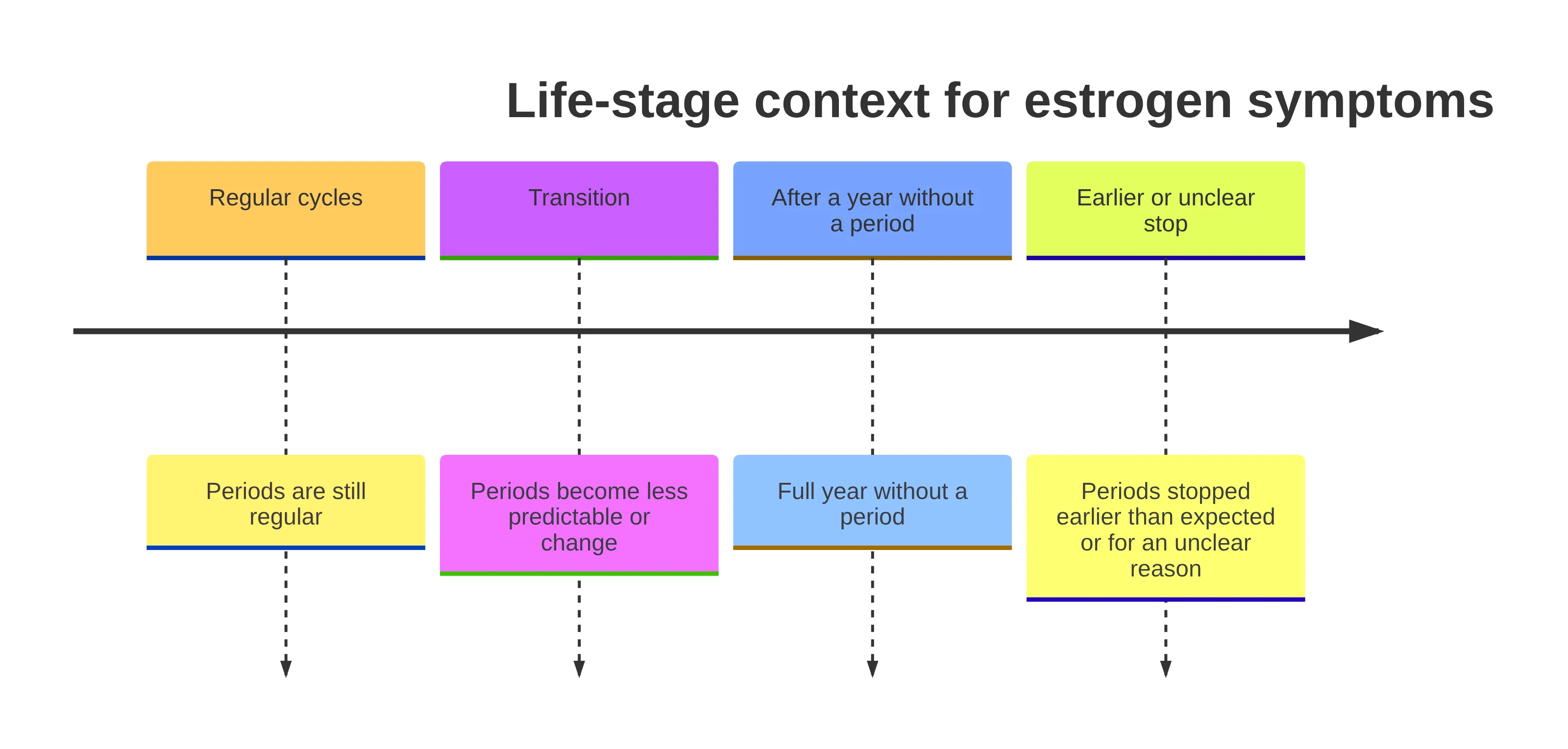
Low estrogen makes more sense when you place the concern on a life-stage timeline. Estrogen does not follow one identical pattern throughout adult life, and a symptom can mean something different during regular cycles, a transition toward the final menstrual period, or the years after that period.
During the transition toward the final menstrual period, which can last several years, estrogen and progesterone may fluctuate widely and eventually decline. The pattern varies from person to person. Your cycle may become less predictable, change in amount or duration, or occur at different intervals. Those changes provide context for other symptoms rather than proving that estrogen is low.
The final menstrual period is identified retrospectively after 12 consecutive months without a period when no pathological cause explains the absence. If you have not reached that point, irregular timing does not by itself establish that estrogen is low. If you have passed that point, a new symptom or any later bleeding deserves a different level of attention than a symptom occurring during a fluctuating cycle.
Write down which description fits your situation:
- Your periods are still regular.
- Your periods have become less predictable or changed in amount, duration, or frequency.
- You have gone through a full year without a period.
- Your periods stopped earlier than expected or have stopped for a reason that remains unclear.
Also record whether the change was gradual or sudden. That timing can help a clinician place your symptoms alongside your reproductive history, medical history, medications, and other possible causes.
Overview
Possible estrogen-related changes can involve several body systems, but no checklist can confirm the cause. Declining ovarian hormones are associated with changes in temperature regulation, the genitourinary system, and psychological well-being. Possible changes include hot flashes, night sweats, trouble falling or staying asleep, mood changes, and a change in sexual desire. Sexual desire may increase or decrease.
A practical overview looks like this:
- Temperature: Hot flashes or sweating episodes may appear, especially when they occur with other cycle or sleep changes.
- Sleep: Trouble falling asleep, staying asleep, or returning to sleep after sweating can become part of the pattern.
- Reproductive changes: Your period may change in regularity, frequency, duration, or amount.
- Vaginal, sexual, and urinary concerns: Changes in sexual desire or genitourinary symptoms may need discussion, but painful urination and urinary changes also require attention to other possible causes.
- Mood and energy: Mood changes can occur during this life-stage transition. Low energy is worth documenting, but it is not specific enough to identify an estrogen cause by itself.
- Timing: The order in which symptoms appear, how often they occur, and whether they cluster around cycle changes can add useful context.
Some symptoms are less obvious because they do not point clearly toward one explanation. Night sweats, sleep disruption, low energy, and painful urination can all prompt a hormone question while also requiring a broader assessment. Treat each symptom as information, not proof.
Record the pattern before interpreting the symptom
The symptom pattern is more useful than a symptom count. A short record can show whether changes appeared together, followed a cycle shift, or developed independently.
Track these details for each concern:
- Start date: Note when the change began and whether it was sudden or gradual.
- Frequency: Record how often it happens and whether the pattern is changing.
- Duration: Write down how long each episode lasts, especially for sweating, sleep interruption, pain, or bleeding.
- Timing: Note whether it occurs during the day, at night, around a period, or at a consistent point in your routine.
- Associated changes: Include cycle changes, mood changes, sleep disruption, sexual changes, urinary symptoms, or new physical concerns that appeared at the same time.
- Impact: Describe what the symptom interrupts, such as sleep, work, exercise, intimacy, or daily activities.
Bleeding deserves precise wording. Record whether the amount, duration, regularity, or frequency differs from your usual pattern. A change in any of those features is considered abnormal uterine bleeding and should be discussed with a clinician.
A pattern record does not prove that estrogen is low. It gives a clinician a clearer starting point for considering your life stage, medical history, medications, examination findings, and other possible causes. Bring the original dates and observations instead of reducing everything to a label.
Read temperature and sleep changes together
Temperature and sleep changes can reinforce each other without proving a hormone cause. Hot flashes or sweating may wake you, and repeated waking can leave you tired the next day. Trouble falling asleep or staying asleep can also occur during the transition toward the final menstrual period, even when sweating is not the main complaint.
Use the combination to ask better questions:
- Does a heat episode wake you, or do you wake for another reason and then feel hot?
- Do night sweats happen on most nights, only around a cycle change, or without a predictable pattern?
- Are your sheets or clothing damp, or do you feel warm without substantial sweating?
- Do you also have changes in your menstrual pattern, mood, or sexual desire?
- Did the sleep change begin before the temperature change?
Night sweats are nonspecific. They can occur with symptoms associated with the reproductive transition, but possible explanations also include thyroid disease, low blood sugar, diabetes, anxiety, or other conditions. A persistent or disruptive pattern therefore deserves more than a symptom match.
Record the episode rather than labeling it. Include the time, duration, sweating intensity, whether it interrupted sleep, and any accompanying symptoms. Note whether it occurred near a cycle change. Bring the record to a clinical discussion so the temperature symptom and the sleep problem can be considered together without assuming they share one cause.
Read reproductive, vaginal, sexual, and urinary changes in context
Reproductive, vaginal, sexual, and urinary changes need context because several different problems can produce overlapping concerns. A changing period may fit the reproductive transition, while bleeding that differs from your normal pattern can require a separate evaluation.
Start with the menstrual history. Note the date of your last period, the usual interval between periods, recent changes in flow, and whether bleeding lasts longer or occurs more often than usual. Bleeding outside your normal amount, duration, regularity, or frequency is abnormal uterine bleeding and should be discussed with a clinician.
Sexual desire can change in either direction. A decrease may be distressing, but an increase is also a change worth recording if it is new for you. Record whether the change appeared alongside sleep disruption, mood changes, cycle changes, discomfort, or medication changes. Do not use desire alone as a measure of estrogen.
Vaginal or urinary concerns should be described specifically rather than grouped under “hormones.” Note discomfort, burning, urgency, frequency, discharge, blood, odor, or difficulty emptying your bladder if any of those occur. Painful urination is not a finding to self-classify as low estrogen; it has its own evaluation questions, including infection and other urinary or genital causes.
If you have gone 12 consecutive months without a period, any later vaginal bleeding warrants prompt medical evaluation. Vaginal bleeding is the presenting sign in more than 90% of women with endometrial carcinoma after the final menstrual period, although bleeding alone does not establish cancer. Do not wait for a symptom diary to become complete before arranging that evaluation.
Include mood and energy changes without over-attributing them
Mood and energy changes deserve attention without being assigned automatically to estrogen. Declining ovarian hormones are associated with psychological symptoms, and mood changes can occur during the transition around the final menstrual period. Sleep disruption can also affect how you feel and function during the day.
Describe the change in concrete terms:
- Are you feeling sad, anxious, irritable, emotionally flat, or unusually overwhelmed?
- Did the change begin with night sweats, sleep disruption, or a cycle change?
- Is low energy present all day, or does it follow poor sleep?
- Has the change affected work, relationships, exercise, concentration, or daily tasks?
- Did a medication, illness, major stressor, diet change, or other health event occur around the same time?
Mood and energy symptoms can overlap with many physical and mental health concerns. A symptom record helps separate an isolated experience from a cluster and gives you language for discussing its impact. It also helps a clinician decide whether the concern should be considered alongside cycle changes, sleep, thyroid or other medical issues, medication effects, or a separate mental health concern.
You do not need to settle on a hormone explanation before asking for help. Describe what changed, when it began, and how it is affecting you.
Test the low-estrogen explanation against alternatives
Symptoms alone cannot confirm low estrogen. A clinician may need to consider your life stage, menstrual history, medications, examination findings, and other possible causes before deciding what the pattern means.
Use an alternative-cause check when a symptom seems to fit:
- Night sweats: Consider thyroid disease, low blood sugar, diabetes, anxiety, and other conditions alongside reproductive hormone changes.
- Absent periods: Consider pregnancy when relevant, thyroid or other medical conditions, changes in exercise or body weight, medications, infections, and mental health concerns.
- Painful urination: Consider the duration and recurrence, fever, flank pain, urgency, frequency, difficulty emptying the bladder, blood or odor in the urine, discharge, pregnancy possibility, recent sexual activity, irritant exposure, or urinary procedures.
- Mood or energy changes: Consider their relationship to sleep, stress, medications, illness, and other symptoms rather than treating them as a hormone measurement.
This is not a request for you to diagnose every possibility. It is a reason to avoid choosing treatment from a symptom list. When several symptoms began together, say so. When one symptom stands apart, say that too. Separating the pattern into clusters can help keep the clinical conversation focused.
The most useful alternative question is often simple: “What else could explain this symptom in my situation?” Write down the answer and any follow-up that your clinician recommends.
Know which bleeding changes should not wait for self-management
Bleeding after the final menstrual period should not be managed as a presumed estrogen symptom. Any vaginal bleeding after you have gone 12 consecutive months without a period warrants prompt medical evaluation, even if the amount is small or the bleeding happens only once.
Bleeding before that point also deserves attention when it is outside your usual pattern. Record the amount, duration, frequency, timing, and whether it recurred. Abnormal uterine bleeding means that menstrual flow differs from your normal volume, duration, regularity, or frequency for you.
The reason for prompt evaluation after the final period is the need to assess the uterine lining and exclude or diagnose important conditions. Vaginal bleeding is the presenting sign in more than 90% of women with endometrial carcinoma after the final menstrual period, but bleeding does not by itself establish cancer. Many causes are possible; the appropriate response is evaluation rather than self-treatment.
Do not wait to decide whether the bleeding “looks hormonal.” Arrange medical care promptly and describe when the bleeding started, how much you noticed, whether it recurred, and whether you have pain or other new symptoms. A clinician can determine which examination or testing is appropriate.
Treat painful urination as a separate evaluation question
Painful urination should be evaluated as its own clinical question rather than counted as proof of low estrogen. Burning or pain with urination can occur alongside other concerns, but the history needs to address urinary, genital, pregnancy-related, infectious, and irritant possibilities.
Before your appointment, note:
- When the pain began and whether it is getting better, worse, or recurring.
- Whether you have fever, flank pain, urinary urgency, frequency, or difficulty emptying your bladder.
- Whether the urine contains blood, looks cloudy, or has an unusual odor.
- Whether you have vaginal or genital discharge.
- Whether pregnancy is possible.
- Whether recent sexual activity, a new irritant, catheterization, cystoscopy, or another urinary procedure could be relevant.
Do not classify painful urination as a hormone symptom before these details have been considered. Arrange an evaluation and describe the symptom clearly, including whether it is new, recurring, or accompanied by any of the changes above.
If painful urination occurs with cycle changes, mention both facts without assuming that one caused the other. The combination may be clinically relevant, but the urinary symptom still needs its own assessment.
What a clinician may need to evaluate
A clinician may evaluate low-estrogen concerns by combining your life stage, symptom pattern, menstrual history, medical history, medications, examination findings, and possible alternative causes. The evaluation is not based on a symptom count alone.
Your menstrual history can be especially useful. Changes in cycles and other symptoms may occur before gonadotropin levels rise, so the timing of your symptoms can matter even when laboratory changes are not yet present. If absent periods occur earlier than expected, blood tests can help confirm the diagnosis and additional testing may look for the cause.
The evaluation may also separate symptoms that need different pathways. Bleeding after 12 consecutive months without a period requires prompt assessment of the uterine lining. Painful urination calls for questions about urinary and genital symptoms, pregnancy possibility, sexual activity, irritants, and recent procedures. Night sweats may require attention to thyroid, blood sugar, diabetes, anxiety, and other possible explanations.
Prepare information that can change the interpretation:
- The date of your last period and your usual cycle pattern.
- The date each symptom began, how often it occurs, and what it interrupts.
- Current medications and supplements, including recent changes.
- Relevant medical conditions, pregnancy possibility, recent illness, and changes in exercise or body weight.
- Whether symptoms appeared together or developed separately.
The purpose of evaluation is to identify the most useful explanation and next step for your situation. A symptom that fits one pattern can still need a different assessment when its timing or accompanying features change.
Build a concise appointment record
An appointment record should be short enough to use during a visit and detailed enough to show change over time. You do not need to track every bodily sensation; focus on symptoms that are new, recurring, disruptive, or connected to your cycle.
Use this one-page structure:
- Timeline: Date of your last period, usual cycle pattern, and the date each new symptom began.
- Temperature and sleep: Hot flashes, night sweats, time of each episode, sleep interruption, and next-day effects.
- Bleeding: Amount, duration, frequency, regularity, and whether bleeding occurred after 12 months without a period.
- Mood and energy: The specific change, its daily impact, and whether it follows poor sleep or another event.
- Sexual and genitourinary health: Change in sexual desire, discomfort, painful urination, urgency, frequency, discharge, blood, or odor.
- Context: Current medications and supplements, recent changes, medical conditions, pregnancy possibility, illness, stress, exercise changes, and recent urinary procedures.
- Questions: What you want clarified about possible causes, evaluation, and treatment options.
Use brief examples instead of broad labels. “Woke twice with damp clothing” gives more context than “bad night sweats.” “Burning began three days ago and returned after improving” gives more context than “urinary symptoms.”
A concise record is a communication aid. It does not need to prove a diagnosis or contain a complete medical history. If you have a symptom that requires prompt evaluation, seek care rather than delaying it to finish the record.
Questions that keep the discussion evidence-based
Useful questions keep the conversation tied to your pattern and circumstances rather than a generic symptom list. Choose the questions that fit your concern:
- Which life stage or cycle pattern best fits the changes I am experiencing?
- Which symptoms could be related to changing estrogen, and which are too nonspecific to interpret that way?
- What other causes should we consider for my night sweats, sleep disruption, mood change, low energy, or absent periods?
- Does my bleeding pattern need prompt evaluation, and what details should I track?
- Does painful urination require a separate urinary or genital evaluation?
- Could any medication, supplement, illness, stressor, exercise change, or pregnancy possibility affect this pattern?
- What examination or testing is appropriate for my symptoms and history?
- If testing is considered, what question is each test intended to answer?
- What changes should prompt me to contact you again rather than continue tracking at home?
- If treatment is discussed, what benefits, limits, alternatives, and follow-up would apply to my situation?
Bring the actual symptom record, not only the label “low estrogen.” Explain what you expected to happen, what changed, and what concerns you most. A clinician can then address the pattern while keeping uncertainty visible where it matters.
You can also ask what should happen next if the first explanation does not account for all of your symptoms. That question keeps one unresolved symptom from being folded into a broader label without further discussion.
Choose evaluation over symptom matching
Possible estrogen-related symptoms are most useful when you connect them to timing, cycle history, associated changes, and possible alternatives. A symptom list can help you start a conversation, but it cannot decide the cause or establish that hormone treatment is appropriate. A qualified clinician should determine individual suitability for evaluation or treatment.
Misra Wellness evaluates and treats symptoms associated with the transition around the final menstrual period, thyroid and hormonal changes, chronic conditions, and complex overlapping symptom presentations. We use evidence-based options, including hormone therapy where appropriate, as part of individualized care.
What should I bring to a discussion about possible low estrogen?
What are common symptoms associated with low estrogen?
Common symptoms may include hot flashes, night sweats, sleep disturbances, mood changes, and alterations in sexual desire. However, these symptoms can also have other explanations.
When should I seek medical attention for symptoms related to low estrogen?
You should seek medical attention if you experience any vaginal bleeding after 12 consecutive months without a period, or if you have symptoms that are severe, persistent, or significantly disrupt your daily life.
How can I prepare for a clinical appointment regarding low estrogen symptoms?
Prepare by tracking your symptoms, noting their onset, frequency, duration, and any associated changes. Bring this information to your appointment to facilitate a more productive discussion with your clinician.
What should I do if I experience painful urination?
Painful urination should be evaluated separately from low estrogen symptoms. Document the details of the pain and any accompanying symptoms, and discuss them with your clinician.
How can I differentiate between low estrogen symptoms and other health issues?
Consider the timing and context of your symptoms, as well as your menstrual history and any recent changes in medications or lifestyle. Discuss these factors with your clinician to help identify the underlying cause.
What is the significance of menstrual changes in relation to low estrogen?
Menstrual changes can indicate fluctuations in estrogen levels, especially during the transition to menopause. However, irregularities do not confirm low estrogen and should be evaluated in the context of your overall health.
What role does life stage play in interpreting symptoms of low estrogen?
Life stage is crucial in interpreting symptoms, as estrogen levels and their effects vary significantly during different phases, such as regular cycles, perimenopause, and postmenopause.
Ready for a real plan?
Work directly with Dr. Misra — no insurance, no rush.
Misra Wellness is a virtual-first Direct Primary Care practice serving California and New York. Book a meet & greet to see if we're the right fit.
Book a meet & greet