
Misra Wellness
Misra Wellness Medical Weight Loss: How to Assess Physician-Led GLP-1 Care

What Misra Wellness offers for medical-weight-loss inquiries
Misra Wellness is a physician-owned Direct Primary Care and Concierge Internal Medicine practice led by Dr. Sulagna Misra, with a physician-directed medical weight-loss program for people who want a clinical discussion about weight or metabolic concerns rather than a medication decision made in isolation. Dr. Misra is a triple board-certified physician and a Board-Certified Medical Affairs Specialist.
If you are researching this option, four questions will give you a clearer basis for deciding whether to inquire:
- What does the program include beyond the medication name?
- How does physician monitoring continue after the initial evaluation?
- Does the self-pay model fit the way you plan to arrange care?
- Does the virtual service context or New York City office location match what you need?
For this program, semaglutide and tirzepatide are prescribed and titrated when clinically indicated. The relevant decision is not whether either medication sounds familiar. The relevant decision is whether a physician-directed evaluation, monitoring plan, and practice model fit your circumstances.
This guide stays with those questions. This guide does not provide individualized prescribing instructions, a diagnosis, a prediction about weight change, or a conclusion that treatment is appropriate for you. The purpose is narrower and practical: help you understand the offering and what an inquiry can establish before you take the next step.
What the medical-weight-loss offering includes
The Misra Wellness medical-weight-loss offering combines physician evaluation, medication decisions when clinically appropriate, and a metabolic plan rather than treating a prescription as the whole service. The service description identifies semaglutide and tirzepatide as medications that Misra Wellness prescribes and titrates when clinically indicated. It also describes evaluation and monitoring with injectable and oral medications when clinically appropriate.
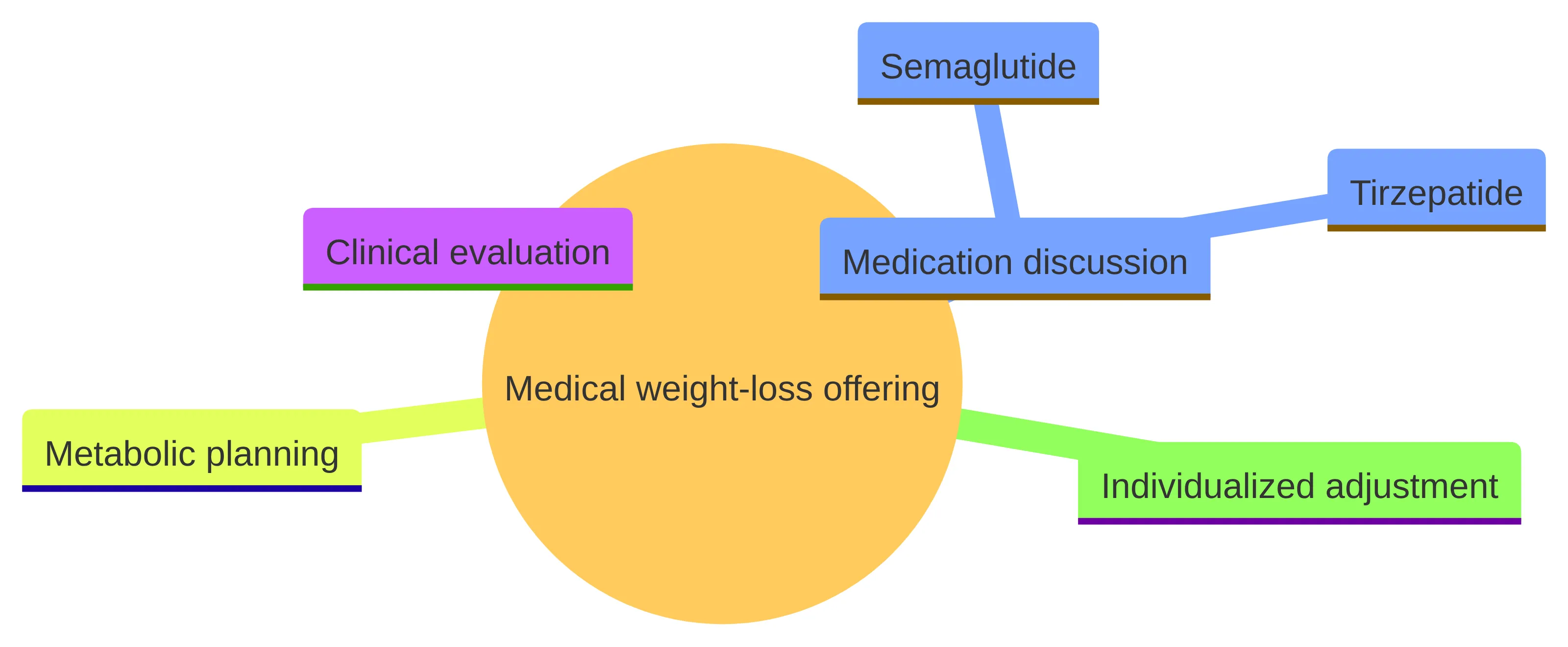
You can understand the offering through four connected parts:
- Clinical evaluation: Dr. Misra evaluates medical weight management in the context of your history, medications, and laboratory results.
- Medication discussion: Semaglutide or tirzepatide may be prescribed and titrated when clinically indicated. The medication name alone does not determine whether it belongs in your care.
- Metabolic planning: The service description pairs medication care with a metabolic plan when clinically appropriate. That keeps the conversation broader than selecting a drug from a list.
- Individualized adjustment: Misra Wellness allows individualized dose adjustments within its weight-loss program, so the stated approach is not a single fixed dose for every person.
These components answer different questions. Evaluation addresses whether the service and a medication discussion fit your clinical context. A metabolic plan addresses how the care is organized around your broader weight or metabolic concerns. Dose adjustment describes how the program can be adapted under physician supervision.
You can use this structure to prepare for a focused conversation without trying to decide your treatment in advance. Write down the main reason you are exploring medical weight loss, the medications and supplements you take, and any relevant laboratory information you already have. That information gives the clinical discussion a usable starting point. It does not determine eligibility or promise that a particular medication will be prescribed.
How physician monitoring continues after evaluation
Physician monitoring at Misra Wellness continues beyond the initial evaluation through dose adjustments, side-effect management, and progress tracking with a physician. That distinction matters if you are comparing a supervised care model with a one-time medication question: the stated program includes follow-up elements that relate to how treatment is monitored over time.
The monitoring process described by Misra Wellness includes:
- Reviewing clinical context: Misra Wellness reviews your history, medications, and laboratory results as part of the weight-management program.
- Adjusting the dose when appropriate: The program allows individualized dose adjustments rather than presenting one dose as suitable for every situation.
- Addressing side effects: Side-effect management is included in ongoing monitoring. You can raise tolerability concerns as part of the clinical discussion instead of treating them as separate from the program.
- Tracking progress: Progress tracking with a physician provides a way to discuss how your care is proceeding and whether the plan needs attention.
This information gives you useful preparation points. Bring a current medication list, a concise account of your weight or metabolic concerns, and relevant laboratory results if you have them. Note questions about dose changes, side effects, and how progress will be discussed. Those questions help you understand the process; they do not amount to instructions for changing a medication yourself.
The practical boundary is simple: online information can explain the structure of the program, but it cannot decide your dose, determine your suitability, or replace the physician’s evaluation of your circumstances.
What the self-pay model means for your inquiry
Misra Wellness operates on a self-pay basis and does not bill commercial insurance, Medicare, or Medicaid. That payment structure is part of the fit decision, not an administrative detail to leave until after you have chosen a treatment path.
If you rely on insurance billing for medical care, the Misra Wellness model may not match the way you normally arrange services. Treat the payment model as an early question about whether the practice belongs in your set of options. You do not need to assume that an insurer will handle the service or that coverage rules will apply in the same way they do elsewhere.
The practice’s terms also explain that required financial and practice documents form part of establishing a physician-patient relationship. You can therefore separate two issues:
- Payment structure: Misra Wellness is self-pay and does not bill insurance, Medicare, or Medicaid.
- Clinical suitability: A physician must evaluate whether medical weight management is appropriate for your circumstances.
Keeping those issues separate prevents a common misunderstanding. A self-pay model does not mean that treatment is automatic, and a clinical inquiry does not change how the practice handles billing. If the model fits your needs, carry payment questions into the appropriate administrative conversation while keeping the medical decision with the physician.
How virtual availability differs from office locations
Misra Wellness is a virtual-first practice serving California and New York, while the listed New York City office is a specific physical location at 65 W 36th St, 10th Floor, New York, NY 10018. Those two details answer different questions: virtual service availability describes how care may be delivered across the stated states, and the office address identifies where an in-person location is listed.
Use the distinction this way:
- If you are in California or New York: The virtual-first service context is the relevant starting point for your location question.
- If you are outside those stated service locations: Do not infer broader availability from the presence of a website or from the New York City address alone.
The office address does not by itself determine whether you qualify for medical weight-loss care. It also does not turn a virtual inquiry into an in-person appointment. Your location, the service format you need, and the practice’s clinical and administrative process remain separate parts of the conversation.
For a location-focused inquiry, state where you are located and whether you are asking about virtual care or the New York City office. That gives Misra Wellness a clear context for responding without requiring you to assume that every service format applies in every location.
What a consultation request does and does not establish
A consultation request to Misra Wellness begins an inquiry; it does not reserve an appointment time, establish treatment eligibility, or create a physician-patient relationship. The contact page describes a 15-minute virtual meet and greet with Dr. Misra by appointment only, with follow-up from a real person. The practice’s terms separately explain the legal and administrative boundary around website contact and consultations.
A contact form submission, appointment request, or scheduled consultation does not by itself establish a physician-patient relationship. Misra Wellness states that this relationship begins only after you and the physician mutually agree to enter one and all required registration, consent, financial, and practice documents are completed.
That means an inquiry can help you ask about:
- Whether your medical-weight-loss question fits the service’s general scope.
- How the physician-led evaluation and monitoring process is organized.
- Whether the virtual service context or New York City office is relevant to your location.
- What administrative steps are required before care can begin.
An inquiry cannot settle those questions as if they were already decided. Website information does not establish that you qualify for treatment or acceptance into the practice. A response or conversation also does not mean that semaglutide, tirzepatide, another medication, or enrollment will follow.
Approach the consultation as a structured opportunity to explain your question and learn about the process. Keep your expectations specific: you are seeking information about suitability, process, and access, not assuming that a submission has already created care.
A practical fit check before requesting a consultation
A practical fit check for Misra Wellness starts with the type of question you want answered, then moves through clinical structure, payment model, location, and administrative expectations. Use the following checklist before you submit an inquiry.
-
Define the clinical question. Write down whether you want to discuss physician-monitored medical weight management, semaglutide, tirzepatide, or another option within the stated service. A medication name can frame the conversation, but it cannot decide what is clinically appropriate for you.
-
Decide whether ongoing supervision is what you want. Evaluation, review of history and medications, laboratory review, dose adjustments, side-effect management, and progress tracking with a physician are part of the described care. If you want a physician-led process rather than a prescription question without follow-up, this structure is relevant to your inquiry.
-
Prepare the information that can make the conversation useful. Gather your medication list, relevant laboratory results, and a short description of your weight or metabolic concerns. Add questions about how monitoring, dose changes, side effects, and progress tracking are handled. You are preparing for evaluation, not choosing a dose in advance.
-
Check the payment model. Under the stated self-pay model, insurance, Medicare, and Medicaid are not billed. If insurance billing is a requirement for you, that is a direct boundary for fit. If self-pay care is workable, keep the financial and administrative questions separate from the clinical question.
-
Match the location context. Care is described as virtual-first in California and New York, with a New York City office at 65 W 36th St, 10th Floor, New York, NY 10018. State your location and the format you are asking about rather than assuming that the office address represents every service option.
-
Set the right expectation for the inquiry. A contact submission or consultation request does not establish a physician-patient relationship or treatment eligibility. The relationship requires mutual agreement and completion of required registration, consent, financial, and practice documents. Keep your goal to understanding suitability and process.
This checklist gives you a clear decision boundary. This option may be relevant when your needs align with physician-directed medical weight management, the self-pay structure, and the stated California, New York, or New York City service context. If one of those conditions does not fit, identify that issue before treating the inquiry as a likely path to care.
Request information without assuming the outcome
Misra Wellness may be relevant if you want physician-directed medical weight management, are considering a discussion involving semaglutide or tirzepatide, and can work within a self-pay model and the stated California and New York service context. The program includes physician evaluation, review of your history and medications, laboratory review, individualized dose adjustments, side-effect management, and progress tracking when clinically appropriate.
A qualified clinician must decide individual suitability. Your location, medical history, medications, laboratory information, and questions about follow-up belong in that discussion. Submitting information does not establish a physician-patient relationship or treatment eligibility; mutual agreement and required registration, consent, financial, and practice documents are required for that relationship.
The clearest next step is to bring a focused question about suitability, process, or access and keep the outcome open until the clinical and administrative details are addressed.
What should you clarify before requesting a consultation?
What services does Misra Wellness offer for medical weight loss?
Misra Wellness provides a physician-directed medical weight-loss program that includes clinical evaluation, medication discussions (semaglutide and tirzepatide), metabolic planning, and individualized dose adjustments.
How does physician monitoring work at Misra Wellness?
Physician monitoring at Misra Wellness includes ongoing dose adjustments, side-effect management, and progress tracking after the initial evaluation.
What does the self-pay model mean for patients at Misra Wellness?
Misra Wellness operates on a self-pay basis and does not bill insurance, Medicare, or Medicaid, which may affect how patients arrange their care.
What is the distinction between virtual services and the New York City office?
Misra Wellness offers virtual-first services for patients in California and New York, while the New York City office is located at 65 W 36th St, 10th Floor, New York, NY 10018.
What should I know about requesting a consultation with Misra Wellness?
A consultation request does not reserve an appointment time or establish treatment eligibility; it begins an inquiry about the services offered.
How can I prepare for a consultation with Misra Wellness?
Before a consultation, gather your medication list, relevant laboratory results, and a brief description of your weight or metabolic concerns to facilitate the discussion.
What is the process for establishing a physician-patient relationship at Misra Wellness?
A physician-patient relationship at Misra Wellness is established only after mutual agreement and completion of required registration, consent, financial, and practice documents.
Ready for a real plan?
Work directly with Dr. Misra — no insurance, no rush.
Misra Wellness is a virtual-first Direct Primary Care practice serving California and New York. Book a meet & greet to see if we're the right fit.
Book a meet & greet