imbalanced hormone symptoms
Imbalanced Hormone Symptoms: How to Read the Pattern and When to Seek Care

Compare symptom clusters with their context
“Imbalanced hormone symptoms” is a shorthand, not a finding by itself. A more useful comparison looks at the shape of the symptom cluster and the context around it:
- Timing: Did symptoms begin alongside cycle changes, arrive together, or appear at different times?
- Shared pattern: Did newly occurring hot flashes appear alongside menstrual-cycle changes?
- Specificity: Are the main complaints fatigue, headache, anxiety, or brain fog—symptoms that can occur across reproductive life stages and do not identify one hormone problem?
- Context: Could the health history point to another explanation that belongs in the clinical discussion?
For otherwise healthy people aged 45 or older with typical symptoms, NICE says newly occurring hot flashes alongside menstrual-cycle changes may be assessed clinically; routine hormone testing is not required. That guidance does not settle every person’s situation, especially when health history or hormonal treatment changes the picture.
There are no out of scope parts here: the focus stays on comparing symptom clusters, keeping broader explanations in view, and preparing focused questions for a clinician.
Use the comparison to make the clinician conversation more precise. Record the first day each change appeared, any relationship to cycle changes, which symptoms arrived together, how long they lasted, and how they affected daily life. Bring that record with your health history and any hormonal treatments, then ask:
- Which features of this pattern are clinically meaningful?
- What other explanations should be considered?
- What examination or clinically appropriate testing, if any, would change the next step?
A symptom record describes what happened; it does not identify a specific hormone problem on its own. A clinician weighs it with individual history, examination, and clinically appropriate testing.
First sort: what changed, and when?
The first sorting step is a timeline. A symptom that began yesterday has a different context from one that has followed a predictable cycle for six months, and a symptom that appears alongside a change in bleeding or temperature regulation deserves a different conversation from an isolated complaint.
Build your timeline around these points:
- Your baseline: Record what your cycles, sleep, temperature comfort, mood, energy, and sexual or urinary health were usually like before the change.
- The first noticeable shift: Write down the approximate date or life period when something became different.
- The pattern since then: Note whether symptoms are daily, intermittent, linked to a cycle, or becoming more frequent.
- Symptoms that arrive together: Mark clusters such as a hot flash followed by night sweating and disrupted sleep, or cycle changes occurring alongside new temperature symptoms.
- The effect on your life: Include missed work, difficulty sleeping, pain, reduced concentration, or changes in intimacy when those effects are present.
If you have had a hysterectomy, the type and combination of symptoms need to be considered instead.
For otherwise healthy people aged 45 or over, these are clinical criteria, not a checklist for self-diagnosis. Your age, health history, cycle history, contraception, and symptom pattern still need to be considered together.
A simple daily record is enough to begin. You do not need to assign a hormone to each symptom. Use dates, short descriptions, and a brief note about severity or effect on your day. The goal is to show the pattern clearly enough for a clinician to ask better follow-up questions.
If your cycle is difficult to track, record what you can: bleeding dates, spotting or other changes you noticed, temperature episodes, sleep interruptions, and whether symptoms appeared together. A partial but dated record is more useful than a confident explanation that you cannot support with observations.
Recognize the common pattern groups
Possible hormone-related changes often appear in groups rather than as a single isolated symptom. The groups below can help you describe what is happening without treating any group as a diagnosis.
- Temperature and sleep: Hot flashes and disrupted sleep are commonly associated with the transition. Record whether waking follows a temperature episode, whether sleep difficulty occurs independently, and how often it happens.
- Cycle and bleeding pattern: Cycle length, timing, and amount of bleeding can change. Note the interval between periods and any meaningful departure from your usual pattern rather than relying on a general description such as irregular.
- Vaginal, sexual, and urinary changes: Vaginal dryness, pain with sex, and urinary symptoms can occur after your final period and may also begin during the earlier transition. Record discomfort, timing, and whether symptoms affect intimacy or urination.
- Mood and cognitive changes: Mood changes and cognitive difficulties can occur, but their relationship with hormone changes is less consistent than the relationship between hot flashes and temperature symptoms. Note anxiety, low mood, irritability, concentration changes, or brain fog alongside sleep and cycle information.
- General symptoms: Fatigue and headache may occur across reproductive life stages. They are useful to record, but they need more context than a symptom label alone can provide.
Patterns vary across the transition. You may notice both cycle-related and temperature symptoms, or you may notice sleep, mood, cognitive, vaginal, urinary, or sexual changes more prominently. A symptom that resembles a familiar pattern does not establish its cause, so describe what is happening in your body and over your own timeline.
The timing between symptoms can be as useful as the symptoms themselves. For example, note whether a temperature episode precedes waking, whether poor sleep precedes a difficult day, or whether discomfort occurs only with sexual activity. These observations do not diagnose the problem, but they give the clinical conversation more detail to work with.
When you review your notes, look for relationships rather than a perfect list. Ask whether symptoms occur together, whether they follow a cycle, whether they interrupt sleep, and whether they are changing your ability to work or participate in daily life. Those observations are more useful for a clinical conversation than a long list without dates.
You can also separate symptoms by how often they occur:
- Occasional: a symptom appears once in a while and then resolves.
- Recurring: a symptom returns in a recognizable pattern.
- Persistent: a symptom continues without a clear break.
- Changing: the frequency, intensity, or effect on daily life is increasing or shifting.
This simple sorting keeps you focused on what changed instead of trying to name a hormone before an evaluation.
Do not let nonspecific symptoms decide the cause
Fatigue, headache, anxiety, and brain fog can occur across reproductive life stages. Their presence alone does not identify a specific hormone problem.
That distinction matters when a symptom feels very familiar. You may recognize your experience in an online list and still need an evaluation to understand what is contributing to it. A cluster can justify a clinical discussion without proving that hormones are the cause.
The same reasoning applies when a symptom affects several parts of your life. Keep those possibilities open while you document the pattern.
A clinician may consider another explanation when the pattern does not fit a typical transition or when your history raises a separate concern. NICE identifies blood-count or thyroid-function testing as examples of investigations that may be considered when another cause of the symptoms is possible.
This does not mean that every symptom requires testing. It means that testing decisions belong inside the clinical context, where your history and examination help determine which questions need answering. A test is most useful when you understand the question it is intended to address.
Avoid turning a symptom list into a treatment decision. When discussing whether treatment is appropriate, your doctor should consider your symptoms, family history, medical history, and preferences together. Your job before that conversation is to describe the pattern accurately, not to select a hormone, medication, supplement, or dose.
Write down what you want help with first. You may want to understand a cycle change, improve sleep, address vaginal or urinary discomfort, or make sense of mood and energy changes. Naming the main concern helps keep the discussion focused without assuming the cause.
Know what clinical context changes the evaluation
Clinical context changes how a clinician interprets the same complaint. In the population described by the guidance, hormone levels fluctuate during the transition, so a single follicle-stimulating hormone result may not clarify the situation or change management.
This is a conditional point, not a universal rule. Your clinician may consider a different approach when your history, symptoms, medication use, or health status does not fit that context.
Tell your clinician about context that can change interpretation:
- Your age and whether your cycles have changed, stopped, or become difficult to interpret.
- Whether you use hormonal contraception or another hormonal treatment, since treatment can make identification more difficult.
- Whether you have had a hysterectomy, because the symptom pattern and surgical history affect how the later stage is identified.
- Whether symptoms are new, persistent, worsening, or occurring with a separate health concern.
These details help distinguish a recognizable clinical pattern from a symptom cluster that needs a broader evaluation.
Routine follicle-stimulating hormone testing is not the same question as all laboratory testing. NICE says routine testing does not help diagnose the transition in otherwise healthy people aged 45 or older with typical symptoms, while other tests may still be considered when another cause is suspected. Ask what a proposed test is meant to clarify and how the result would affect the next decision.
If a test is suggested, ask what information it adds to your history and symptom pattern. If testing is not suggested, ask what clinical features support that approach. Either answer can be reasonable when it matches your circumstances.
If treatment enters the discussion, bring your preferences into it. U.S. guidance from the National Institute on Aging describes symptom burden, family and medical history, and personal preferences as part of deciding whether and how to address symptoms. That discussion should follow evaluation rather than be replaced by a self-assigned hormone explanation.
You can ask what problem a proposed option is intended to address, what other approaches may be considered, and what follow-up would involve. Keep the focus on your circumstances rather than on matching yourself to a treatment described online.
When to arrange a focused clinical discussion
A routine clinical discussion is appropriate when symptoms are bothersome, persistent, or affecting sleep, mood, work, intimacy, or daily activities. Common symptoms can still deserve attention even when they are not specific to one cause. You do not have to wait until the pattern becomes unbearable before discussing it.
Use the effect on your life as part of your decision. If you are missing work, waking repeatedly, avoiding intimacy because of discomfort, or struggling to manage ordinary tasks, record that plainly. The impact is clinically relevant context, even when the symptom itself is nonspecific.
Arrange a focused evaluation rather than relying on symptom matching when hormonal treatment makes your cycle difficult to interpret, when the pattern is changing, or when you want to discuss whether treatment is appropriate. Bring the timeline and ask what needs attention first. Do not start, stop, or adjust a treatment based only on a symptom list.
If your symptoms change while you are waiting for an appointment, update your record with the date and the new detail. If a clinician has already given you instructions for contacting the office or seeking urgent care, follow those instructions.
Build a concise clinician-ready symptom record
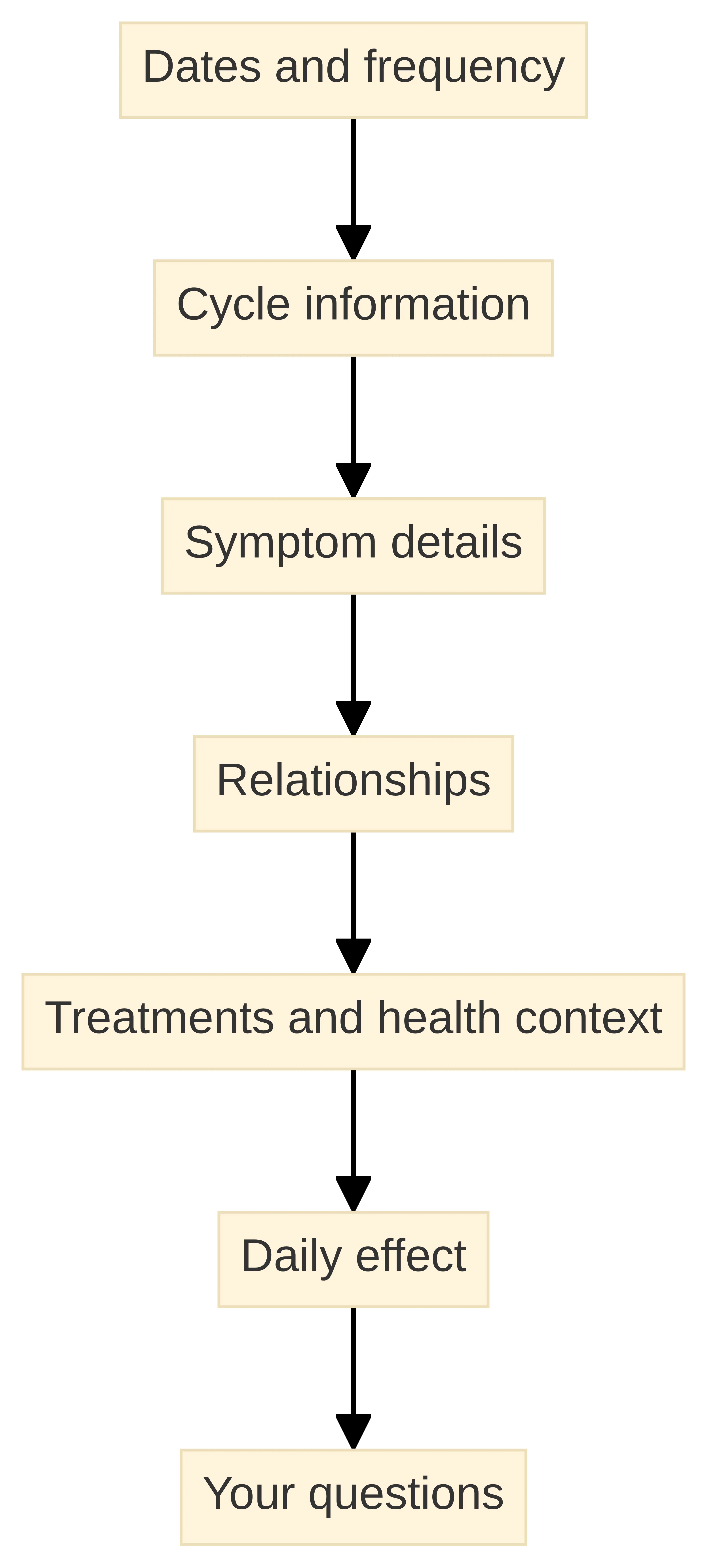
A concise record can make an appointment more focused. You can use a notebook, calendar, or phone note. Include the following:
- Dates and frequency: Write when each symptom began, how often it occurs, and whether it is becoming more or less frequent.
- Cycle information: Record period dates, changes in cycle length, changes in bleeding amount, and the date of your last period if applicable.
- Symptom details: Describe hot flashes, night sweats, sleep disruption, mood changes, concentration problems, fatigue, headache, vaginal dryness, pain with sex, or urinary symptoms in plain language.
- Relationships: Note which symptoms appear together and whether a symptom follows a cycle, interrupts sleep, or occurs independently.
- Treatments and health context: List hormonal contraception or other hormonal treatment, major health conditions, and any recent change that may affect interpretation.
- Daily effect: Record missed work, reduced concentration, difficulty sleeping, pain, changes in intimacy, or other effects that matter to you.
- Your questions: Keep the questions short enough to answer during the visit.
Useful questions include:
- Does this pattern fit a reproductive life-stage transition, or should we consider another explanation?
- Does my age, cycle history, contraception, or hormonal treatment change how you interpret these symptoms?
- Would a blood count, thyroid-function test, or another clinically appropriate evaluation help answer a specific question?
- Would routine follicle-stimulating hormone testing add useful information in my situation?
- Which changes should prompt me to contact you sooner?
- If treatment is discussed, how do my medical history, family history, symptoms, and preferences affect the decision?
- What should I track between visits, and what change would make you reassess the plan?
These questions keep the discussion focused on interpretation and next steps rather than on obtaining a predetermined diagnosis or treatment.
Bring the record even if the pattern feels messy. A short note that says symptoms appeared on different days, changed over time, or did not follow a clear cycle is still useful. Do not fill gaps by guessing which hormone is involved. Mark uncertainty plainly and let the clinical discussion address it.
To keep the record manageable, put your three main concerns at the top. Add a short list of medications, hormonal products, or supplements you use, along with any recent change in how you take them. The point is not to create a perfect diary; it is to make the most relevant facts easy to find.
If you are balancing work and health care in California or New York, a dated record can help you use appointment time efficiently. Keep the record concise enough to share, and place your two or three biggest concerns at the top. You can bring a printed page or use a note on your phone, whichever makes the information easiest for you to review.
Ask what testing would change
A useful clinical question is: “What would a test change about the next step?” Hormone levels fluctuate during the transition, so NICE notes that routine FSH testing may not clarify the picture in some clinical situations. When another cause is possible, a clinician may consider tests such as a blood count or thyroid-function testing. A dated record gives you a practical way to explain what changed and what you need to understand next.
A qualified clinician must decide which evaluation and treatment options are appropriate for you based on your history, examination, symptoms, preferences, and any clinically appropriate testing.
At Misra Wellness, we evaluate and treat hormone imbalance and complex primary-care concerns. We also evaluate and treat thyroid and hormonal changes, chronic conditions, and complex overlapping symptom presentations. Bring your symptom record to a clinician-led discussion so the focus can remain on your history and the questions that need answers.
What should you ask before discussing possible hormone-related symptoms?
What are common symptoms associated with hormonal changes during menopause?
Common symptoms during the menopause transition can include hot flashes, vaginal dryness, sleep disturbances, and mood changes. These symptoms may vary in intensity and frequency among individuals.
How can I prepare for a consultation regarding my symptoms?
To prepare for a consultation, keep a symptom record that includes dates, frequency, and details about your symptoms, as well as any changes in your menstrual cycle, mood, and daily life impact. This will help your clinician understand your situation better.
What should I discuss with my clinician during my appointment?
During your appointment, discuss your symptom patterns, any changes in your health, your medical history, and your preferences regarding treatment options. This will help your clinician tailor a plan that suits your needs.
How does age affect the evaluation of menopause symptoms?
If you are 45 or older, your clinician may use clinical history and symptom patterns to evaluate menopause without routine hormone testing, as hormone levels can fluctuate during this transition.
What role do laboratory tests play in diagnosing menopause?
Routine laboratory tests, such as follicle-stimulating hormone (FSH) testing, are generally not needed to diagnose menopause in otherwise healthy individuals aged 45 or older with typical symptoms, as these tests do not change management.
What is the significance of tracking my symptoms over time?
Tracking your symptoms over time helps identify patterns and changes, which can provide valuable information for your clinician to make informed decisions about your evaluation and treatment options.
Ready for a real plan?
Work directly with Dr. Misra — no insurance, no rush.
Misra Wellness is a virtual-first Direct Primary Care practice serving California and New York. Book a meet & greet to see if we're the right fit.
Book a meet & greet