
how fast lose weight
How Fast Can You Lose Weight? A Safe, Realistic Guide for Midlife Women

Weight-loss pace is not a deadline
Weight-loss pace is a changing range, not a deadline you have to meet. A clinical review states that medical guidelines often describe 1–2 pounds per week as a safe rate, but that figure is not a universal target for every person.
Weight-loss pace may change over time because metabolic adaptations can reduce metabolic rate and daily energy costs as body weight decreases. An early change on the scale therefore does not establish the rate you should expect later. A slower period does not, by itself, explain why the change occurred or determine whether your approach is appropriate.
The practical question is not whether you can force a particular weekly number. The better question is whether your expectations, habits, symptoms, and health goals make sense together. Use general ranges as context, then use a clinician discussion to place your own pattern in context rather than judging yourself against a fixed schedule.
Overview
Weight loss does not move at one identical speed for everyone. A clinical review describes 1–2 pounds per week as a general medical-guideline reference, while another review of National Institutes of Health guidance describes an expected range of 0.5–1 kilogram per week. Those figures overlap closely, but neither should become a personal requirement. Pace can also change as body weight decreases, and midlife weight changes can involve several interacting factors rather than a single cause.
This guide helps you make four distinctions:
- A weekly figure can provide context without predicting your result.
- Genetics, energy intake relative to expenditure, physical activity, and environment can shape the pattern.
- Hormonal transition, aging, body-composition changes, and lifestyle factors can overlap in midlife.
- Tracking a few relevant patterns and discussing them with a clinician can help you choose a more informed next question.
Guideline recommendations emphasize complex contributors and goals based on your needs, preferences, and shared decision making.
General information can help you interpret a range, but it cannot establish your diagnosis, select medication, or create a personalized weight-loss plan. Your next step should match what you want to understand: the pace itself, a change in symptoms, a pattern that has stalled, or the broader metabolic and hormonal context.
Use weekly figures as context, not a promise
The 1–2-pound weekly figure is a general reference described by a clinical review, not a result you are expected to produce. The same number can mean different things in different circumstances, and a weekly average can hide normal variation from one measurement to the next. Treat the range as a way to question an expectation, not as a score for your body.
A review of National Institutes of Health clinical guidelines describes a 500–1,000 kcal per day caloric deficit aimed at an expected rate of 0.5–1 kilogram per week. That converts to roughly 1.1–2.2 pounds per week. The review also explains that its expected rate may not remain constant as metabolic rate and the energy cost of daily activity change with lower body weight.
The slight difference between the two ranges is not a reason to choose the larger number or to combine the figures into a personal target. It is a reminder that guidance may use different units and wording. When you compare a weekly figure with your own experience, ask three questions:
- Is the figure being presented as general context or as a personal expectation?
- Does the guidance explain the conditions behind the figure?
- What changes when your weight, activity, sleep, symptoms, or goals change?
Those questions preserve the useful part of a range without turning it into a timetable. One further distinction is useful: a “safe rate” and an “expected rate” are not interchangeable labels. The first describes how a source frames safety; the second describes what a guideline-based program aims to produce. Neither label says that the outcome will occur for every person or remain steady over time. Converting kilograms to pounds only changes the unit; it does not make the guidance more precise for an individual. When an online statement removes those limits, treats the upper end as the goal, or frames a slower period as failure, it has changed context into pressure. Return to the narrower question: what does this general figure help you understand, and what individual information is still missing?
Avoid treating a slower week as a command to make a more aggressive change on your own. A rate is meaningful only alongside the approach used to reach it, the health factors involved, and whether the approach fits your needs. If the number is creating pressure or confusion, bring that concern to a qualified clinician rather than chasing a faster result.
That caution also applies to the 500–1,000 kcal per day figure described in the guideline review. In the review, it appears as part of a program aimed at an expected range; it is not a calculation this article can assign to you. The review itself notes that the expected rate may change as body weight and energy needs change. Reading the figure as a universal prescription would remove the context that gives it meaning.
A safer way to use the numbers is to ask what they can and cannot answer. They can show why a general reference range is often discussed. They cannot tell you whether a particular pace is appropriate for your health history, whether a change reflects body composition, or whether your current approach should be changed. They also cannot establish eligibility for a medication or another intervention. If your main concern is pressure to speed up, uncertainty about a slower pattern, or confusion about what the range means, make that the subject of the clinician conversation. This keeps the number in its proper role: background for a question, not an instruction.
Why the same approach can produce different rates
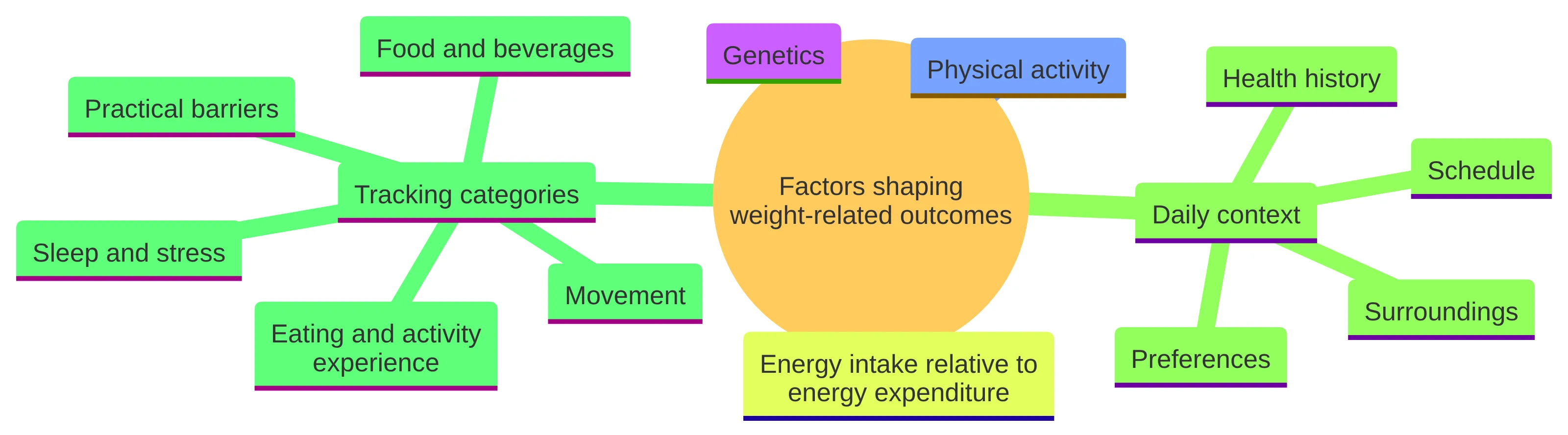
Weight-related outcomes can reflect genetics as well as behavioral and environmental factors. Physical activity and energy intake relative to energy expenditure are part of that picture, but they do not operate in isolation from your schedule, surroundings, health history, and preferences. Two people can follow broadly similar routines and still see different changes over the same period.
Daily context can make a routine easier or harder to maintain. Tracking these details does not tell you the cause of a weight change, but it can give you a clearer record of what was happening around the change.
Use the following categories to notice patterns without turning the record into a test:
- Food and beverages: Record what you consume for several days, including the circumstances around meals and drinks.
- Movement: Note the activity, time of day, and duration rather than relying on a general impression of how active you were.
- Sleep and stress: Record sleep hours and the stressors or coping methods that shaped the day.
- Eating and activity experience: Note whether hunger, mood, fatigue, or other feelings affected your choices.
- Practical barriers: Record travel, work demands, caregiving, pain, schedule changes, or other challenges that altered your routine.
The purpose is observation. You do not need to interpret every entry or assign blame to a single factor.
A useful interpretation asks what changed around the same time as the weight pattern. That might include a change in sleep, activity, eating routine, stress, or a health concern, but the record alone cannot tell you which explanation applies. Bring the pattern to a clinician when you want help deciding what deserves further discussion.
Why midlife body changes add context
Midlife weight changes can involve aging, hormonal factors, diet, physical activity, sleep, and other behavioral factors. One review defines midlife as ages 40 to 65 and describes weight gain during that period as involving hormone, physical, and lifestyle changes. That combination matters because the same scale result can sit within several overlapping changes in your body and routine.
Muscle mass is another part of the context. One review states that women naturally lose muscle mass at a rate of 3% to 8% per decade after age 30, which may reduce calories burned at rest. This is a population-level observation, not a way to estimate your own body composition or explain your own weight without evaluation.
A longitudinal study found increased fat mass and a declining proportion of lean mass during the midlife hormonal transition. The study reported that body-composition changes accelerated during that transition by a 2- to 4-fold increase in fat gain or loss of proportion of lean mass. Body composition and body weight are related, but they are not identical measurements.
The same longitudinal study found that body weight and body mass index climbed steadily before and during the hormonal transition without a transition-related acceleration, and that weight did not increase further after the transition in the study population. That finding is useful precisely because it separates the study’s weight pattern from its body-composition pattern. A change in fat mass, lean mass, or body weight should not automatically be treated as interchangeable with the others.
Your hormonal transition may be relevant to a weight change, but it is not automatically the sole cause. Aging, sleep, activity, food patterns, stress, body composition, and other health factors can overlap. A practical question is not whether you can assign the entire pattern to one life stage; it is which parts of the pattern you want a clinician to evaluate.
Before a visit, describe what changed and when:
- Did the scale change gradually or in a noticeable shift?
- Did sleep, activity, stress, or eating patterns change at the same time?
- Are you more concerned about weight, body composition, symptoms, energy, or several of these together?
- What would make the discussion useful for you?
These questions organize the conversation without assuming a diagnosis or deciding what treatment you need.
One reason to keep these questions separate is that a scale result and a body-composition result answer different questions. The longitudinal study described changes in fat mass and proportion of lean mass, while its weight and body mass index pattern did not accelerate in the same way. So a reader cannot infer from the speed of scale change alone what happened to fat or lean mass. Likewise, the study’s population-level pattern cannot determine what is happening in one person.
That distinction can make a clinician conversation more precise. If the concern is the number on the scale, say so. If the concern is how clothing fits, strength, energy, symptoms, or a perceived change in body composition, say that instead. These concerns may overlap, but they should not be silently substituted for one another. The purpose is not to collect more measurements for their own sake. It is to identify which change you want interpreted and avoid asking a general weekly range to answer a question it was not designed to answer.
Expect the pace to change over time
A slower period needs context rather than an immediate judgment. The change may relate to lower energy needs, a different routine, normal variation, or another factor that requires discussion. The cited guidance explains a mechanism that can alter pace; it does not tell you why your own pace changed.
When the pattern changes, pause before making a major adjustment. Compare the timing with your tracking record, note any new symptoms or routine changes, and decide whether you want clinician input. That approach keeps the next question specific without turning a general explanation into a personalized plan.
It also helps to separate three ideas that are often collapsed into one number. Direction describes whether weight is changing. Pace describes how quickly that change occurs across a period of time. Maintenance asks how a longer-term goal might be supported after an initial change. These ideas are related, but one cannot stand in for the others. A slower pace is not automatically an explanation of why the pattern changed, and an early pace should not be treated as a schedule that must continue indefinitely.
Misra Wellness states that it develops a realistic long-term maintenance strategy for weight loss. That makes maintenance a separate question to raise, not an outcome to assume. You can ask how a proposed goal would be revisited if pace changes and what information would be used to judge whether it remains realistic. The answer should be shaped by clinician discussion, rather than by extending an early weekly average indefinitely.
Track patterns instead of judging one scale result
A tracking record gives you organized observations to discuss; it does not diagnose the reason for a weight change or determine the right treatment.
A simple record can include:
- What you ate and drank over several days.
- What activity you did, when you did it, and how long it lasted.
- How many hours you slept.
- What stressors were present and how you responded to them.
- How you felt around eating and activity.
- Which practical challenges made your usual routine different.
Use the same broad categories each day, but do not make the record so demanding that it becomes another source of pressure. To turn those entries into a useful discussion, review them in three passes:
- Describe: What changed in the record, and when?
- Separate observation from explanation: Which details occurred together, and which conclusions are you only considering?
- Prioritize: Which question do you most want answered?
This sequence keeps tracking in its proper role. A record can show that a weight pattern occurred alongside changes in sleep, activity, stress, food or beverages, or practical barriers. It cannot by itself determine whether one factor caused the change or how genetic, hormonal, and environmental influences interacted. The CDC framing is to use tracking to notice possible small changes, not to turn every entry into a verdict about effort.
If the record contains several concerns, bring the broader pattern but lead with the concern that matters most to you. For example, you might want to understand the timing of a change, decide what information to discuss, or clarify how a goal should be revisited. Those are different questions even when they arise from the same notes. Keeping them separate can make a clinician conversation more focused without turning the record into a diagnosis, treatment choice, or personalized plan.
Use the record as a starting point rather than a pass-or-fail report. A gap in the notes does not settle why the scale changed, and a detailed record does not establish a single explanation. Its value is that it gives you concrete observations to share while leaving interpretation open to discussion.
After you have a record, look for timing rather than a perfect pattern. You might ask whether a weight change appeared alongside a sleep disruption, a work or caregiving change, less activity, a shift in meals, or a new concern about your health. You can bring those observations to a clinician and ask which details matter for the next evaluation.
Do not use a tracking record to prove that you caused a weight change or to decide that you need a specific medication. The immediate use is narrower: organize what happened, identify the question you want answered, and make the discussion easier to start.
Choose shared goals over a fixed target
Guidance summarized in a review recommends assessing readiness for lifestyle changes and, when appropriate, formulating weight-loss goals and complementary lifestyle strategies with a clinician. Readiness is not a character judgment. It is a practical question about what you can discuss, try, monitor, and revisit in your current circumstances.
Choose the next question that matches your situation:
- If you are trying to understand a changing pattern: Bring the timing, relevant routine changes, and your main concern to a clinician. Ask what context would help interpret it.
- If you are ready to discuss a weight-loss goal: Ask how the goal should reflect your needs, preferences, health context, and readiness rather than a fixed weekly result.
- If you are unsure what goal makes sense: Start with the decision you want help making. A clinician can discuss whether weight, symptoms, body composition, or another health concern should guide the conversation.
- If a target is making you feel pressured: Set the number aside and describe the pressure or uncertainty directly. That is a valid reason to seek a more individualized discussion.
Each branch leads to a conversation, not an automatic treatment choice.
Shared decision making does not mean you have to arrive with a finished plan. It means your priorities and circumstances belong in the discussion. You can ask what a proposed goal is meant to address, what information would change it, and when the plan would be reconsidered.
A useful goal can have more than one layer. The first layer may be the question you want answered now: why a pattern changed, how to interpret a general range, or which factors deserve discussion. The next layer may be a health or weight-related aim that fits your needs and preferences. A further layer is how you will revisit that aim if your circumstances, symptoms, routine, or pace changes. This structure prevents a single weekly figure from carrying every decision.
It also gives you a way to describe readiness without treating it as all-or-nothing. You may be ready to organize your observations but not ready to discuss an intervention. You may be ready to discuss goals but still need help understanding which factors matter. Or you may want to discuss longer-term maintenance before deciding what an initial goal should be. Those are different starting points, and a clinician conversation can make the distinction explicit.
Long-term maintenance is a separate topic to raise when you want to discuss how a goal could be revisited if your circumstances, symptoms, routine, or pace changes. Separating that question from the initial rate keeps an early weekly average from carrying the entire decision. It also leaves room to discuss what information would matter if the pattern changes, rather than assuming that the same interpretation will apply throughout. A useful conversation can address the immediate question and the longer-term question without treating either one as settled in advance. You can therefore include maintenance among the questions you want to understand, while keeping the article’s boundary clear: a general guide cannot determine which goal, evaluation, or approach is appropriate for you.
Know what a clinician discussion can clarify
At Misra Wellness, we consider thyroid, hormone, and metabolic factors alongside medication in our weight-loss program. Dr. Sulagna Misra also evaluates complex primary care concerns. This means your question can include more than whether a medication exists. You can also ask how the clinician will think about the health factors that may be relevant to your pattern.
A general article cannot determine whether a particular medication, test, or intervention is appropriate for you. A clinician discussion can instead help clarify which concerns belong in evaluation, what information is still needed, and which goals you want to address first. Do not treat a symptom or scale pattern as a diagnosis.
Consider bringing these prompts:
- What changes in weight, symptoms, sleep, activity, or eating should I describe first?
- Which thyroid, hormonal, metabolic, or other health factors might be relevant to discuss?
- What would you need to know before discussing options?
- How should we define a useful goal and decide when to revisit it?
The prompts keep the visit focused without telling you what conclusion it should reach.
A practical discussion can move in stages. First, describe the pattern you want understood and the time period involved. Next, explain whether your main concern is the scale, body composition, symptoms, energy, or the interaction among several concerns. Then ask which thyroid, hormonal, metabolic, lifestyle, or other health factors belong in the evaluation. Finally, clarify how a goal would be defined and when it would be revisited if the pace changes. This sequence organizes the conversation without assuming that any one factor is the cause.
You can also ask the clinician to distinguish what is known from what still needs clarification. A population-level finding about midlife body composition may provide useful context, but it does not identify your individual pattern. A general weekly reference may help frame expectations, but it does not select a personal target. Tracking may show that a change occurred alongside sleep, activity, stress, or eating-pattern changes, but it does not establish why. Keeping those boundaries visible makes it easier to discuss the right question rather than asking one measure to answer several different questions.
If your concern is not speed itself, say that directly. You may want to understand a changing pattern, discuss a realistic goal, consider longer-term maintenance, or decide what information would be useful next. The clinician discussion can then begin with your actual priority instead of an assumed deadline.
Prepare a focused question for physician-led evaluation
A focused question gives a clinician a clearer starting point than a demand for a particular weekly result. Consulting with a clinician trained in hormonal transition care at Misra Wellness can help create a tailored health plan. Your role is to describe what changed, what you want to understand, and what kind of discussion would be useful.
Prepare a short set of notes before the discussion:
- Your main question in one sentence.
- The approximate timing of the weight or symptom change.
- Relevant food, activity, sleep, stress, and lifestyle patterns.
- Any changes that happened at the same time.
- The concern you most want addressed first.
The CDC’s tracking categories can help you organize this information, but you do not need a perfect record before asking for help.
You might ask:
- Could my weight pattern be discussed alongside thyroid, hormonal, metabolic, or other health factors?
- Which details from my notes are most useful for the evaluation?
- How should we describe a realistic goal without making a weekly number the only measure?
- What should I understand before discussing weight-loss options?
These questions invite physician-led evaluation without assuming eligibility, treatment selection, or a particular outcome.
If you are not ready to discuss treatment, you can still ask for help understanding the pattern and deciding what information matters next. If you are ready to discuss options, bring the same context and let the clinician determine what evaluation is appropriate for you.
Key Highlights
- No universal pace applies: A clinical review describes 1–2 pounds per week as a general reference, not a target for every person.
- Weekly figures are context: Another review describes an expected range of 0.5–1 kilogram per week and explains that pace may change as body weight decreases.
- Midlife factors can interact: Aging, hormonal factors, diet, activity, sleep, and other behavior can all belong in the context of weight changes.
- Your goal should fit your situation: Guideline recommendations emphasize complex contributors, personal needs, preferences, readiness, and shared decision making.
- A focused discussion can help: Tracking relevant patterns and bringing specific questions can make it easier to discuss what deserves evaluation.
Use these highlights as a decision aid: set aside a fixed deadline, describe the pattern you want understood, and choose whether your next step is continued observation or a clinician discussion.
Request a consultation without assuming the outcome
A weekly figure is context for discussion, not a personal target or a deadline.
A qualified clinician must decide what evaluation or care is appropriate for you. It does not establish a diagnosis, treatment selection, eligibility, outcome, or personalized weight-loss plan.
If you want physician-informed discussion of weight-related, metabolic, thyroid, or hormonal concerns, submitting the form is an optional next step. Submitting the form does not reserve an appointment time.
What should you discuss during a weight-loss consultation?
What factors influence how fast weight may be lost?
Weight loss pace can be influenced by several factors including genetics, energy intake relative to expenditure, physical activity, hormonal changes, aging, sleep, and stress. These elements can interact in complex ways, especially during midlife.
How can midlife changes affect weight loss?
Midlife changes, including hormonal shifts, aging, and lifestyle factors, can impact weight loss.
What should I track to understand my weight changes better?
Consider tracking your food intake, physical activity, sleep patterns, stress levels, and any lifestyle challenges. This information can help identify patterns and inform discussions with a clinician.
How does metabolic adaptation affect weight loss over time?
Metabolic adaptation can slow weight loss as body weight decreases, meaning that the energy required to maintain a lower weight may differ from what was needed at a higher weight. This can lead to changes in the pace of weight loss.
What role does a clinician play in weight loss management?
A clinician can help evaluate your weight pattern in the context of your overall health, consider hormonal and metabolic factors, and assist in setting realistic weight loss goals tailored to your individual needs.
Ready for a real plan?
Work directly with Dr. Misra — no insurance, no rush.
Misra Wellness is a virtual-first Direct Primary Care practice serving California and New York. Book a meet & greet to see if we're the right fit.
Book a meet & greet