
low estrogen symptoms
Low Estrogen Symptoms: What They May Mean and When to Seek Care

Low estrogen symptoms are clues, not a diagnosis
Low estrogen symptoms can be clues that your body is moving through a hormonal transition, but symptoms alone cannot establish that low estrogen is the cause. The same experience may have another explanation, and the meaning depends on your life stage, menstrual pattern, health history, and the combination of symptoms.
The most useful starting point is pattern recognition rather than self-diagnosis. Hot flashes and night sweats can occur during the transition out of reproductive cycling. Vaginal dryness, painful intercourse, and urinary symptoms may occur during the transition and after the final menstrual period. Sleep disruption can occur during this transition, sometimes alongside night sweats. Mood changes, depressive symptoms, and difficulty concentrating can occur during the same period, but their connection to hormonal change is less specific.
That distinction does not make mood, memory, or sleep concerns less real. It tells you how to frame them: as symptoms that deserve context and, when they interfere with your life, a clinician discussion.
A symptom map can help you organize what you are noticing before you arrange care. Use it to describe timing, body system, and effect on daily life—not to select hormone treatment or decide that one explanation is certain. Symptoms during reproductive transition can affect quality of life and may go unaddressed in primary care, so bringing a clear account of what has changed gives the discussion a practical starting point.
What low estrogen means during reproductive transition
Low estrogen during reproductive transition refers to the decline in ovarian estrogen secretion that accompanies the end of reproductive cycling. That transition involves more than estrogen alone: ovarian secretion of androgens and progesterone also declines, and the resulting hormonal changes may affect multiple body systems.
The transition is not always a sudden change. Hormonal fluctuations can occur alongside irregular menstrual cycles and a broad range of symptoms. Your symptoms may therefore vary from week to week or change as the transition progresses. A fluctuating pattern does not prove a hormonal cause, but it is useful information to bring to a clinician.
The final menstrual period marks a clinical boundary rather than a symptom you can identify from one missed cycle. Clinicians define the end of reproductive cycling after 12 consecutive months without menstruation, provided another medical cause does not explain the absence of menstruation. The transition leading up to that point can last several years and often begins during the fifth decade of life, although your own timing may differ.
Life stage changes how symptoms are interpreted. A hot flash during a period of irregular cycles has a different context from a new urinary or vaginal concern after the final menstrual period. Neither pattern gives you a diagnosis by itself. Both are worth describing accurately.
A life-stage map: fluctuating transition versus time after the final period
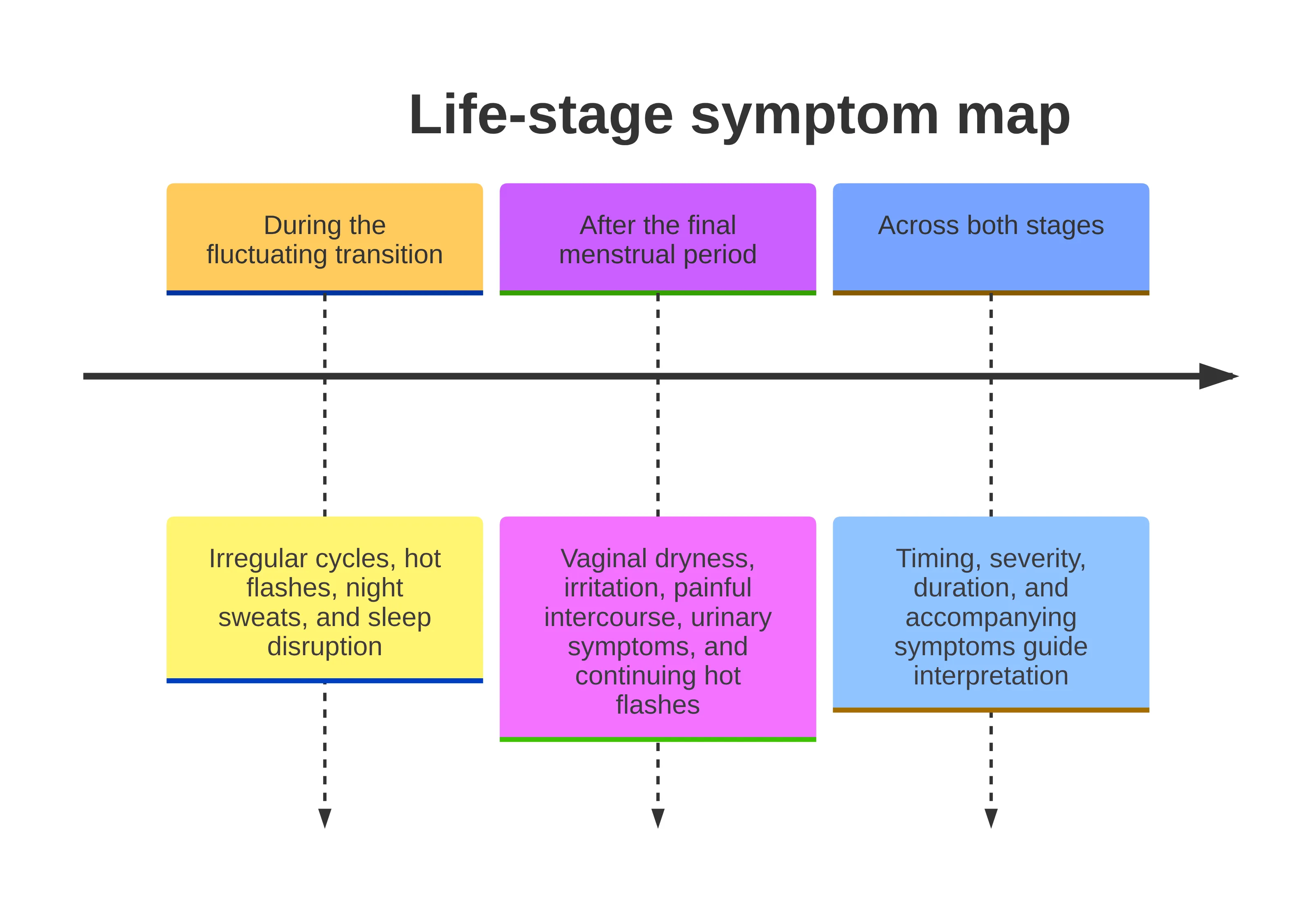
A life-stage map separates symptoms that occur during fluctuating reproductive transition from symptoms that continue or emerge after the final menstrual period. Use the two stages as organizing categories, not as a test for estrogen deficiency.
- During the fluctuating transition: Irregular menstrual cycles may occur with hot flashes, night sweats, sleep disruption, changes in mood, sexual changes, or other symptoms affecting quality of life. Hormonal fluctuations can make the pattern uneven rather than steadily progressive.
- After the final menstrual period: Vaginal dryness, irritation, painful intercourse, and urinary symptoms may occur or continue. Hot flashes and night sweats may also remain part of the picture, while symptoms may lessen for some people over time.
- Across both stages: A symptom may be associated with hormonal change without being caused by low estrogen. Timing, severity, duration, and accompanying symptoms still matter.
The practical boundary is simple: record which stage seems to fit your history, then let a clinician interpret the pattern.
The transition can affect more than temperature or menstrual timing. Sexual function, sleep, mood, and quality of life may change during the same period, but these areas do not all have the same degree of connection to hormonal change. Vaginal and urinary symptoms have a clearer physical relationship to declining estrogen-related tissue changes, while mood and cognitive concerns need a wider assessment.
Write down the stage-related details that you know: whether your periods are still occurring, whether they have become irregular, and whether 12 months have passed since the last one. If you are unsure how to classify your stage, that uncertainty is itself a reasonable question for a clinician.
Temperature and sleep symptoms
Hot flashes and night sweats are common physical symptoms associated with reproductive transition. The experience can be brief or disruptive; the pattern is more useful than a single episode.
Sleep disruption can occur alongside night sweats. Record whether you have trouble falling asleep, wake during the night, wake because of heat, or feel that sleep is affecting your daytime functioning. Those details help separate a temperature symptom from the broader sleep concern you want to discuss.
A temperature-and-sleep record can include:
- The date and approximate time of each hot flash or night sweat.
- Whether the symptom occurred during the day or woke you at night.
- How often it occurred and whether it interrupted sleep.
- Any change in daytime concentration, mood, or energy that you associate with poor sleep.
- Whether the symptom appeared during an irregular-cycle pattern or after the final menstrual period.
The record does not determine the cause. It gives you a concrete account to discuss instead of relying on a general impression that you have felt different lately.
Vaginal, sexual, and urinary symptoms
Vaginal dryness, vulvovaginal irritation, painful intercourse, and urinary symptoms can occur during reproductive transition and after the final menstrual period. These symptoms are associated with estrogen-related tissue changes, and they may affect comfort, sexual function, and daily life.
Vaginal symptoms are not limited to dryness. You may notice irritation, discomfort during intercourse, changes in sexual function, or urinary concerns. Describe the specific experience rather than using a broad label. “Intercourse became painful,” “urination changed,” and “dryness began after my cycles became irregular” give a clinician more useful information than “my hormones are low.”
The timing of sexual symptoms can also vary. Pain during intercourse may occur earlier in the transition, while changes in desire may occur later, but your pattern may not follow a fixed sequence. Urinary symptoms may occur during the transition or after the final menstrual period.
Bring up these concerns directly, even if they feel private or difficult to explain. Include when the symptom began, whether it is changing, what activities it affects, and whether it occurs with other symptoms such as hot flashes, sleep disruption, or irregular periods. A clinician can decide what context and evaluation are appropriate for you.
Mood, depression, and cognitive changes need more context
Depressive symptoms can occur during perimenopause, including alongside hot flashes, sleep disturbance, and psychosocial challenges. That distinction matters because a change in mood or concentration should not automatically be assigned to estrogen.
You may notice sadness, loss of interest, irritability, difficulty concentrating, or a sense that your thinking has changed. These experiences deserve attention on their own. Depression during the transition may occur alongside hot flashes, sleep disturbance, and psychosocial challenges, so describe the complete pattern rather than reporting only a hormone concern.
Depressive symptoms require more than a symptom match. Tell a clinician when the change began, how long it has lasted, whether sleep or temperature symptoms appeared at the same time, and how the change affects work, relationships, or daily activities. Include any prior history of depression if that applies to you; clinical guidance notes that most midlife women who experience a major depressive episode during this period have had a prior depressive episode.
Cognitive changes also need a careful description. Note whether you are having trouble finding words, concentrating, remembering tasks, or completing work, and whether poor sleep appears alongside the concern. A clear account helps keep mood, sleep, life circumstances, and hormonal transition in the same conversation without treating any single factor as the answer.
Mood and cognitive symptoms can be meaningful without proving low estrogen. Arrange a clinician discussion when they persist, worsen, or interfere with daily life, and describe them with the same care you would give a physical symptom.
Why the same symptom may have another explanation
The same symptom may have another explanation because hormonal transition affects many systems while symptoms themselves are not unique to one cause. A sleep problem, mood change, concentration concern, or sexual change may occur during the same life stage without being caused by low estrogen. A symptom can be genuine and disruptive while its cause remains uncertain.
Physical symptoms are not automatically conclusive either. Hot flashes, night sweats, vaginal dryness, painful intercourse, and urinary symptoms have recognized associations with reproductive transition, but an association is not a diagnosis. Your life stage, symptom timing, related changes, and health history all contribute to clinical interpretation.
Use the symptom pattern to decide whether to arrange an evaluation, not to diagnose yourself or choose treatment. Keep the question open enough for a clinician to consider the full context. Ask whether the pattern fits hormonal transition, whether another explanation needs attention, and what information would clarify the next step.
When symptoms deserve a clinician discussion
Symptoms deserve a clinician discussion when they disrupt sleep, sexual comfort, urination, mood, concentration, work, relationships, or other parts of daily life. Symptoms during reproductive transition can affect quality of life and may remain unaddressed in primary care.
Arrange an evaluation when symptoms persist, worsen, return after a period of improvement, or concern you even if their effect is difficult to measure. A discussion is also appropriate when your menstrual pattern has changed and you are unsure which life stage you are in. The purpose is to interpret the pattern, not to obtain a diagnosis from a checklist.
Before contacting a clinician, organize four points:
- What changed: Name the symptom in plain language, such as night sweats, vaginal dryness, painful intercourse, urinary symptoms, low mood, or concentration difficulty.
- When it changed: Give the approximate start date, frequency, duration, and whether symptoms follow a cycle or occur unpredictably.
- What it affects: Explain whether sleep, work, relationships, sexual comfort, mood, or daily activities have changed.
- What else changed: Include menstrual timing, other symptoms, medication questions, and relevant health-history details.
This preparation does not establish low estrogen. It makes the clinical conversation more specific.
Build a symptom record before the visit
A symptom record gives you a short, organized account of what happened, when it happened, and what it affected. Use a notes app, calendar, or paper page—the format matters less than recording the pattern consistently enough to describe it.
Include these fields:
- Date and symptom: Record the day and the specific experience rather than a general label.
- Frequency and duration: Note how often it occurred and how long each episode lasted when you can estimate it.
- Cycle or life-stage context: Record whether you had a menstrual period, an irregular cycle, or no period during the relevant time. Note whether 12 consecutive months have passed since the final period if that applies to you.
- Body-system details: Separate temperature symptoms, sleep disruption, vaginal or sexual symptoms, urinary symptoms, mood changes, depressive symptoms, and cognitive concerns.
- Effect on daily life: Write down missed sleep, reduced concentration, discomfort, changes in sexual activity, or other practical effects.
- Questions and history: Add medication questions, relevant health history, and anything that changed around the time symptoms began.
A record is a communication tool. It does not prove that estrogen is low or identify which treatment, if any, is appropriate.
Use the record to look for connections without forcing a conclusion. You might notice that night sweats precede poor sleep, that vaginal discomfort affects sexual function, or that mood changes appear during a period of disrupted sleep. Write those observations as questions rather than causes: “Could these symptoms be related?” is more useful than “This proves my estrogen is low.”
Bring the record to the visit or use it to prepare a concise summary. If your notes are incomplete, bring what you have. A clear description of a few representative days can still help you explain what has changed. To make that summary easier to use, end it with three brief statements: what changed first, what is most disruptive now, and what you want clarified. If several symptoms began around the same time, list them together rather than assigning one cause. This keeps the visit focused on timing, impact, and questions that can be evaluated.
Questions to bring to the clinician
Questions for a clinician can keep the discussion focused on interpretation rather than symptom matching. Consider bringing this list:
- Could my symptom pattern fit reproductive transition, or should we consider other explanations?
- How does my menstrual history affect the way these symptoms should be understood?
- Which symptoms are more closely associated with hormonal change, and which need a broader assessment?
- What details about my sleep, mood, sexual function, urinary symptoms, or concentration would be useful to discuss?
- What health-history or medication information should I include?
- Which changes should prompt a follow-up discussion if they continue or worsen?
- What evaluation is appropriate for the symptoms I am describing?
- How should I describe the effect of these symptoms on work, relationships, sleep, or daily activities?
You do not need to answer every question before the visit. Mark the questions that match your concerns and bring your symptom record with them.
A clinician discussion should include the symptoms that feel easiest to dismiss. Mood changes, cognitive concerns, painful intercourse, and urinary symptoms can affect quality of life even when they are uncomfortable to describe. Naming them directly gives the clinician a fuller picture of your concerns and keeps the evaluation from focusing only on hot flashes.
Choose evaluation over symptom matching
Symptoms can point toward a useful clinical conversation, but no symptom list can establish low estrogen as the cause. A practical next step is to record the timing, life-stage context, body system involved, and effect on your daily life, then discuss the pattern with a qualified clinician who can decide what it means for you.
You are not required to wait for certainty before asking for help. If symptoms persist, worsen, or interfere with sleep, mood, comfort, or daily activities, bring your record and questions to an evaluation. A qualified clinician must decide individual suitability for any evaluation or treatment.
What should I track before discussing possible low estrogen symptoms?
What are common symptoms associated with low estrogen?
Common symptoms include hot flashes, night sweats, vaginal dryness, painful intercourse, urinary issues, sleep disturbances, mood changes, and cognitive difficulties. These symptoms can vary based on life stage and hormonal fluctuations.
When should I consider discussing my symptoms with a clinician?
You should consider a discussion when symptoms disrupt your daily life, such as affecting sleep, mood, or sexual comfort, or if they persist, worsen, or change after a period of improvement.
How can I prepare for a clinician visit regarding low estrogen symptoms?
Prepare by recording the timing, frequency, and impact of your symptoms, along with any relevant health history and questions you may have. This will help facilitate a focused discussion.
What does low estrogen mean in the context of reproductive transition?
Low estrogen refers to the decline in ovarian estrogen secretion that occurs during the transition to menopause, which can affect multiple body systems and lead to various symptoms.
Can symptoms of low estrogen have other causes?
Yes, symptoms can be associated with hormonal changes but may also arise from other factors. It’s important to discuss the full context with a clinician to determine the underlying cause.
What should I include in my symptom record before visiting a clinician?
Include the date and specific symptoms experienced, their frequency and duration, any menstrual cycle context, and how these symptoms affect your daily life.
What questions should I ask my clinician about my symptoms?
Consider asking how your symptom pattern relates to reproductive transition, what additional evaluations may be needed, and how your menstrual history affects symptom interpretation.
Ready for a real plan?
Work directly with Dr. Misra — no insurance, no rush.
Misra Wellness is a virtual-first Direct Primary Care practice serving California and New York. Book a meet & greet to see if we're the right fit.
Book a meet & greet