
glp1 and alcohol
GLP-1 and Alcohol: A Medication-Specific Guide to Safer Next Steps
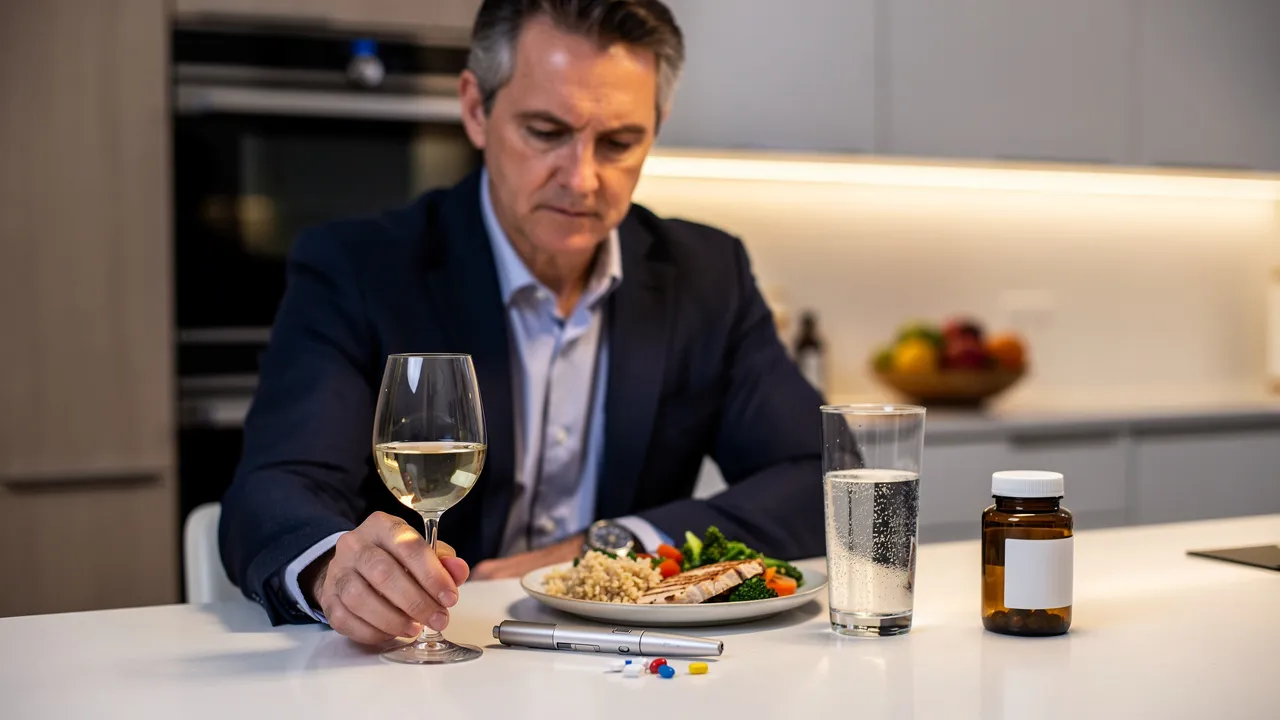
Which GLP-1, which circumstances, and what goal?
GLP-1 treatment and alcohol use do not have a universal yes-or-no answer. Your medication, treatment goal, other glucose-lowering medicines, treatment stage, symptoms, hydration, nutrition, medical history, and drinking pattern all belong in the discussion before you decide whether to drink.
This guide has no out of scope parts: it focuses on how alcohol may interact with GLP-1 treatment, what established medication guidance says, what remains uncertain about alcohol cravings, and what to discuss with a qualified clinician. It does not determine an amount or type of alcohol for you, diagnose alcohol use disorder, or tell you to change a medication independently.
GLP-1 medicines are not one identical treatment. Semaglutide, tirzepatide, and liraglutide have medication-specific information, and your risks may also change if you take insulin or a sulfonylurea, have difficulty eating, or are starting or increasing a dose.
GLP-1s were first approved for type 2 diabetes in 2005. GLP-1 receptor agonist medications are FDA-approved for treating diabetes and obesity, while their use for substance use disorders remains an area of emerging research. That distinction sets the direction for this article: use established medication guidance for immediate safety questions, and treat claims about reduced alcohol cravings as research to discuss rather than as a reason to self-treat.
Start by identifying the question you actually need to answer. “Can I drink?” may mean whether alcohol could worsen nausea, whether it could affect blood sugar, whether your medication information includes a specific warning, or whether you are wondering about changes in alcohol cravings. Those are different questions and may require different information.
Your treatment goal matters too. The approved uses described in the cited material are diabetes and obesity; research into substance use disorders is separate. A change in cravings may be worth mentioning, but it does not replace a medication review or establish that the treatment is intended for alcohol-related concerns.
A useful first step is to write down your exact medication, formulation if known, dose, date of the latest dose change, other glucose-lowering medicines, and any recent nausea, vomiting, diarrhea, constipation, reduced appetite, or difficulty eating. Add the reason you are considering alcohol and the question you want answered. This gives your clinician a specific starting point instead of relying on a general statement about the entire medication class.
Recognize the gastrointestinal symptoms that can complicate drinking
Gastrointestinal symptoms can make an alcohol decision less predictable during GLP-1 treatment. Constipation and nausea are among the most common side effects described with GLP-1 use, particularly when treatment starts. An ADA/EASD consensus report described nausea, vomiting, and diarrhea as gastrointestinal side effects that tend to occur during initiation and dose escalation and diminish over time.
The symptom list is not identical for every medication, dose, treatment stage, or person. Your current symptoms matter more than a general statement that alcohol is or is not allowed.
Before drinking, consider these practical boundaries:
- If nausea, vomiting, or diarrhea is already affecting your ability to eat or drink, postpone the decision and contact your prescribing clinician.
- If constipation or nausea began after starting treatment or increasing the dose, ask whether the timing changes your plan.
- If you are between dose changes and feel well, do not treat that as proof that alcohol will have the same effect after your next dose.
- Do not use alcohol to test whether a symptom is medication-related.
The ADA/EASD consensus report recommended moderating alcohol intake and increasing water intake during GLP-1 receptor agonist therapy. That is general guidance, not an individualized amount. A clinician who knows your medication and health history can explain whether you should avoid alcohol while symptoms are present or while your dose is changing.
Food and fluid intake deserve their own place in the decision. Nausea, vomiting, diarrhea, constipation, and reduced appetite can change how much you eat or drink. The cited guidance connects GLP-1 treatment with gastrointestinal symptoms during treatment initiation and dose escalation, so a planned social occasion may fall at a different point in your treatment than the last time you drank.
Do not interpret a symptom-free day as a permanent answer. A dose increase, a return of nausea, or a period in which you cannot eat normally changes the circumstances you need to discuss. If drinking would require you to ignore symptoms, postpone the decision and contact your prescribing clinician.
Keep the question narrow and practical: “I am taking this medication at this dose, I recently experienced these symptoms, and I am considering alcohol. What should I do if eating or drinking becomes difficult?” That question invites medication-specific instructions without asking you to create your own limit.
Consider hydration, meals, and blood-sugar risk together
Hydration, meal timing, and blood-sugar risk can overlap when you combine alcohol with GLP-1 treatment. One clinical source reported that GLP-1 use can reduce thirst and cited guidance recommending eight to 10 glasses of water or sugar-free beverages a day to help mitigate constipation and nausea. The ADA/EASD consensus report also recommended increasing water intake and moderating alcohol during GLP-1 receptor agonist therapy.
That hydration guidance does not create a universal drinking rule. If nausea, vomiting, or reduced appetite means you are eating or drinking less than usual, alcohol may add another concern to review rather than something to manage by guesswork.
Do not force yourself to follow a general fluid target if a clinician has given you different instructions because of another health condition. Instead, bring both sets of instructions to the conversation and ask which plan applies to you.
Medication-specific information also differs:
- Tirzepatide information from Mayo Clinic stated that drinking alcohol may cause severe low blood sugar and advised discussing alcohol with your health care team.
- Liraglutide information from Mayo Clinic stated the same warning and advised discussion with your health care team.
- Semaglutide itself does not cause hypoglycemia, but low blood sugar can occur with insulin or sulfonylureas, delayed or missed meals, increased exercise, alcohol use, or an inability to eat because of nausea or vomiting.
These statements should not be flattened into a single rule for every GLP-1 medication. In particular, the semaglutide information distinguishes the medicine itself from circumstances and combinations that may be associated with low blood sugar. Your other medicines, recent food intake, exercise, and ability to eat may therefore matter as much as the GLP-1 name.
Before making a decision, write down:
- The exact GLP-1 medication, formulation, and dose.
- The date of your last dose change.
- Any insulin, sulfonylurea, or other glucose-lowering medicine you take.
- Whether you have been eating and drinking normally.
- Recent exercise, nausea, vomiting, diarrhea, constipation, or reduced appetite.
- The medication-specific question you want answered.
Do not skip, double, or alter a prescribed dose to make room for alcohol. If you have missed a meal, cannot eat because of nausea or vomiting, or are unsure how another medicine affects blood sugar, contact your health care team instead of trying to resolve the situation through trial and error.

Check medication-specific warnings and medical history
Medication-specific warnings and medical history can change the alcohol discussion. Liraglutide information states that a history of alcohol use disorder or gallstones may increase the risk of pancreatitis in people using liraglutide.
If you use liraglutide and have either history, tell your health care team before deciding about alcohol. Do not assume that information about semaglutide or tirzepatide answers the question for liraglutide, and do not assume that a warning for one medication applies in exactly the same way to another.
Your clinician should also know about:
- The exact GLP-1 medication and formulation you use.
- Any insulin, sulfonylurea, or other glucose-lowering medicine.
- Whether you are starting treatment, increasing the dose, or recovering from nausea, vomiting, diarrhea, or poor intake.
- A history of alcohol-related concerns, gallstones, or other conditions already discussed with your care team.
This review is not a diagnosis. It is a way to put the medication information beside the facts that determine how it applies to you.
Bring the medication container, current medication list, and recent dose history if you contact your care team. Include whether the question concerns a single planned occasion, repeated alcohol use, a change in cravings, or a symptom you are experiencing now. The purpose is not to justify a predetermined amount. It is to help your clinician distinguish a medication warning from a symptom problem, a blood-sugar concern, or an alcohol-related concern that needs separate support.
If you do not know which information applies to your medication, do not fill the gap with advice for another GLP-1. Ask for instructions tied to the exact product and your other medicines.
Separate alcohol-craving research from established GLP-1 guidance
Alcohol-craving research is not the same as established guidance for taking a GLP-1 medication. A scoping review included five studies of GLP-1, GIP, and/or glucagon receptor agonists for substance use disorders. Three studies showed positive results and two found no efficacy, and the review described human safety and efficacy evidence as limited. The included studies varied widely in patient selection, dose or formulation, and follow-up.
Early animal and human research suggests GLP-1 treatments may reduce alcohol and other substance use, while some small clinical trials have shown encouraging results. “Encouraging” does not mean established, and it does not establish a medication as treatment for alcohol-use disorder or alcohol cravings.
If you notice fewer cravings while using a GLP-1, mention that observation to your clinician rather than changing your medication plan around it. If alcohol feels difficult to control, ask directly for appropriate clinical support. Do not start, stop, increase, or repurpose a GLP-1 medication to address alcohol use without a clinician’s evaluation.
The limits of this research matter when you interpret a headline or personal experience. The included studies did not all use the same patient selection, dose or formulation, or follow-up period. Three positive findings and two findings without efficacy do not produce a consistent treatment answer for every person using a GLP-1.
A change in alcohol cravings may also have several possible explanations, and current research does not establish how to use a GLP-1 for that purpose. Treat the observation as a question for your clinician, not as proof that the medication is treating alcohol use. If you are concerned about cravings, loss of control, or alcohol-related harm, bring that concern forward directly rather than waiting to see whether the GLP-1 changes it.

Interpret reported risks without changing treatment independently
A real-world comparative study reported that GLP-1 receptor agonists were associated with a modest but statistically significant increase in the risk of acute pancreatitis and pancreatic cancer compared with DPP-4 inhibitors. That result is an association reported in one study, not a prediction of your personal risk and not a reason to stop prescribed treatment on your own.
Reported risks need context: the medication, the condition being treated, other medicines, medical history, symptoms, and the clinician’s interpretation all matter. The study’s comparison also does not answer whether alcohol is appropriate for you.
If this finding concerns you, bring the study question to your prescribing clinician in a specific form: “Does this reported association change how you assess my medication, alcohol use, or follow-up?” Keep taking or adjusting treatment only as directed while you wait for an individualized answer. Do not substitute an online risk comparison for a medication review.
An association is not an individualized forecast. It does not tell you that a serious outcome will occur, and it does not show that alcohol is the cause of a particular outcome for you. It does justify a focused discussion if the result relates to your medical history, medication, or symptoms.
Do not stop treatment, change the dose, or use alcohol as an informal test of risk. Ask which findings in your history matter, whether your medication-specific information changes the discussion, and what symptoms or circumstances should prompt contact with your care team.
Know when to stop self-managing and seek care
Self-management should stop when alcohol, medication, or symptoms create a question you cannot answer from your prescribed instructions. Use these boundaries:
- Before drinking: Contact your health care team if you do not know whether your exact medication has an alcohol warning, if you use insulin or a sulfonylurea, or if you have a history of alcohol use disorder or gallstones while using liraglutide.
- With severe low blood sugar: Do not try to solve the situation by changing your GLP-1 dose. Contact your health care team promptly, and seek urgent medical attention if the symptoms are severe or you cannot safely wait.
- With nausea or vomiting that prevents eating: Contact your prescribing clinician rather than deciding independently whether to drink, skip a dose, or change a dose. Seek urgent medical attention if the situation is severe or you cannot safely manage it at home.
- With alcohol-use concerns: If you are worried about cravings, loss of control, or how alcohol fits with treatment, raise that concern directly with a clinician. Do not treat a GLP-1 as an established treatment for alcohol-use disorder.
The goal is not to label your symptoms. The goal is to move from self-management to professional assessment when medication warnings, food and fluid intake, blood sugar, or alcohol-related concerns make the decision uncertain.
Use a simple escalation plan:
- Pause the drinking decision if you are unsure about your medication-specific warning, cannot eat normally, or are experiencing significant nausea, vomiting, or other symptoms.
- Contact your prescribing clinician or health care team for instructions tied to your medication, dose, other medicines, and medical history.
- Seek urgent medical attention when low blood sugar or vomiting is severe, when you cannot safely manage the situation at home, or when waiting for routine advice is not safe.
- Do not compensate by skipping, doubling, or independently changing a prescribed dose.
This plan does not tell you how much alcohol to drink. It tells you when the question has moved beyond a general article and requires clinical assessment.
Prepare focused questions for the prescribing clinician
Questions for a prescribing clinician can turn a general alcohol question into a medication-specific review. Bring the exact medication name, dose, treatment stage, other medicines, recent symptoms, and usual drinking pattern so the discussion is concrete.
Ask:
- Does my exact GLP-1 medication have an alcohol warning, and does my current dose change that advice?
- Do insulin, a sulfonylurea, or another glucose-lowering medicine change my blood-sugar risk with alcohol?
- What should I do if I delay or miss a meal, exercise more than usual, or cannot eat because of nausea or vomiting?
- Should I avoid alcohol while I am starting treatment or increasing the dose?
- How should I respond to nausea, vomiting, diarrhea, constipation, reduced appetite, or reduced thirst?
- Does my history of alcohol use disorder or gallstones affect the discussion if I use liraglutide?
- Which symptoms mean I should contact the care team promptly rather than wait for a routine follow-up?
- If I notice changes in alcohol cravings, how should we discuss them without treating the GLP-1 as a medication for alcohol-use disorder?
Write down the answer to each question and the instruction for missed meals, symptoms, or dose changes. A clear plan is more useful than relying on a general statement about GLP-1 treatment.
Choose a clinician-guided next step
Misra Wellness includes a candidacy evaluation to assess the appropriateness and safety of GLP-1 therapy. We prescribe and titrate semaglutide and tirzepatide when clinically indicated, include ongoing physician follow-up in our medical weight loss program, and allow individualized dose adjustments.
Bring your medication list, dose history, recent gastrointestinal symptoms, meal and hydration concerns, other glucose-lowering medicines, relevant medical history, and alcohol-related questions to that discussion. Do not change treatment to accommodate alcohol or use a GLP-1 to manage cravings independently. A qualified clinician decides individual suitability and the appropriate plan for your circumstances.
Practical questions about GLP-1 treatment and alcohol
Can alcohol cause low blood sugar with semaglutide?
Semaglutide itself does not cause hypoglycemia, but low blood sugar can occur when alcohol is combined with insulin or a sulfonylurea, missed or delayed meals, increased exercise, or an inability to eat because of nausea or vomiting. Ask your clinician how your full medication and meal pattern affects your risk rather than assuming the answer applies to every GLP-1 treatment.
Are GLP-1 medications approved to treat alcohol cravings or alcohol-use disorder?
No. GLP-1 medications are FDA-approved for diabetes and obesity, while their use for alcohol cravings or alcohol-use disorder remains emerging research. Early findings are mixed and limited, so do not start, stop, increase, or repurpose treatment for alcohol concerns without a clinician’s evaluation.
What should you tell a clinician before drinking alcohol during GLP-1 treatment?
Provide the exact medication, formulation, dose, date of the latest dose change, other glucose-lowering medicines, recent nausea or vomiting, ability to eat and drink normally, relevant history such as gallstones or alcohol-related concerns, and your planned drinking situation. Ask about medication-specific warnings, blood-sugar risk, symptoms that require prompt attention, and whether you should postpone alcohol while starting or increasing the dose.
Ready for a real plan?
Work directly with Dr. Misra — no insurance, no rush.
Misra Wellness is a virtual-first Direct Primary Care practice serving California and New York. Book a meet & greet to see if we're the right fit.
Book a meet & greet